Protein Synthesis
This resource explains the intricate process of protein synthesis, detailing how DNA and RNA collaborate to code for proteins and influence traits. It covers critical steps, including transcription, where mRNA is created from DNA, and translation, where the ribosome assembles amino acids into proteins. Key differences between DNA and RNA, such as nitrogenous bases and structural composition, are highlighted. By understanding these processes, one can appreciate how genetic information translates into the proteins that determine biological functions and characteristics.

Protein Synthesis
E N D
Presentation Transcript
Protein Synthesis Mrs. Harlin
3.1.2 • Explain how DNA and RNA code for proteins and determine traits.
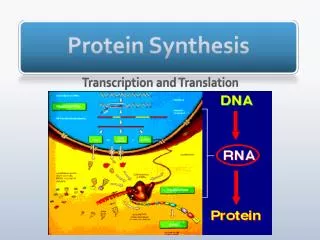
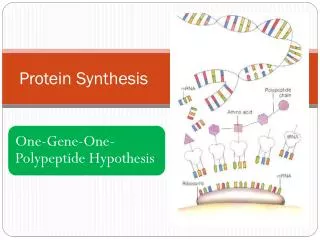
Transcription Translation Protein Synthesis DNA mRNA Trait Protein
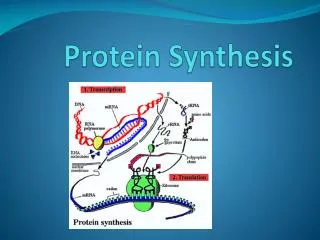
Step 1- Transcription Transcription makes an mRNA copy of DNA in the nucleus of the cell. If the DNA reads: TAC GTA GCA The mRNA (messenger) will read: AUG CAU CGU
What is the difference? • DNA has T (Thymine) and RNA does not! • Instead RNA has U (Uracil). • If the DNA strand has a T you will still write an A for the RNA like you would do during DNA replication. • If the DNA strand has an A you will write a U for the RNA because RNA does not have T.
The Other Differences • 1. So RNA has U’s, DNA has T’s. • 2. RNA is single stranded; whereas, DNA is double stranded. • 3. RNA is made of the sugar ribose; whereas, DNA is made of the sugar deoxyribose.
Step 2 Translation • The mRNA goes to a ribosome, made of rRNA, where the amino acids are brought and dropped off by a tRNA (transfer) to make the protein. • If the mRNA reads: • AUG CAU CGU • The tRNA will read: • UAC GUA GCA
The Protein • To figure out the sequence of amino acids the protein will have, you must use the mRNA codon chart in your textbook (pg. 211). • Look up the mRNA codons: • If the mRNA reads: • AUG CAU CGU • The amino acids will be: • Start histidine arginine
The Protein • The protein is formed by polypeptide chains, which are just amino acids linked by peptide bonds. • Proteins can be structural (forming part of the cells materials) or functional (hormones, enzymes, or chemicals involved in cell chemistry).