Understanding Protein Synthesis: From DNA to Functional Proteins
This review delves into the intricate processes of protein synthesis, highlighting the essential roles of DNA replication, transcription, and translation. DNA is copied accurately to produce messenger RNA (mRNA), which communicates genetic instructions to ribosomes for protein assembly. The significance of proteins in cellular structure, function, and chemical reactions is emphasized. Key topics include the distinction between exons and introns, types of RNA (mRNA, tRNA), and the role of codons in translating genetic information into functional proteins, demonstrating how the genetic code determines biological diversity.

Understanding Protein Synthesis: From DNA to Functional Proteins
E N D
Presentation Transcript
Review • Purpose of DNA Replication • Copy DNA exactly to put into a new cell
Protein Synthesis • Using the DNA code to make proteins • Each gene gives you a protein with a function
Importance of Proteins • Every chemical reaction and structural component in your body • Materials that make up structure of cells • Enzymes • Communication between cells • Hormones
Gene • A section of DNA that codes for a protein • Example: • Gene: DNA sequence for hitch-hiker’s thumb (instructions) • Protein: builds your thumb cells so that they bend back (physical outcome)
2 sections of DNA • Exons:genes that code for a protein (1%) • Introns: Sequences of DNA that do not code for a protein (extra DNA) (99%)
RNA • Another nucleic acid used in Transcription and translation
DNA vs. RNA DNA RNA Ribose AUCG 1 Very small (1000 bp) Transcription/Translation/Other • Deoxyribose • ATCG • 2 • Very large (3 billion bp) • Genetic code
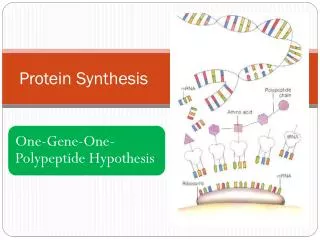
Types of RNA • mRNA: messenger RNA. Carries message of DNA from Nucleus to ribosome • tRNA: transfer RNA. Transfers amino acids from cytoplasm to ribosome to create protein
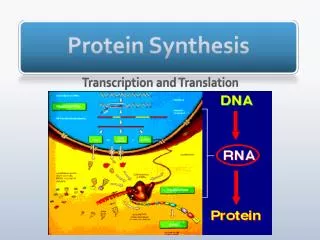
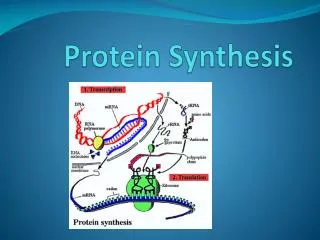
Transcription • Creating a copy of the DNA to travel to the ribosome to make proteins • DNA can’t leave nucleus so it has to copy the gene it wants
Transcription • DNA mRNA (messenger RNA) complimentary bases line up along the DNA • mRNA travels to ribosome
Enzyme • RNA polymerase builds mRNA
One Change • Thymine doesn’t exist outside of the nucleus so Uracil matches with Adenine instead. So instead of A=T we get A=U. • Transcribe the following gene: ATGCAATGCGATG
Answer • UACGUUACGCUAC
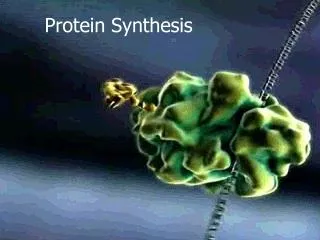
Translation • translating the code of mRNA into a chain of amino acids (protein) • mRNA feeds through ribosome • tRNA brings the correct amino acid to the ribosome • another tRNA brings the next amino acid and connects it to the first
Translation • Keeps going until we have a chain of about 100 amino acids (protein) • When it hits a stop codon the protein breaks off and goes to be used in the cell
Translation • Codon: A triplet of bases on the mRNA • Anticodon: Found on the tRNA, complimentary triplet to mRNA (helps line up the tRNA and the mRNA)
Practice • Divide the following into codons: AUGCCUGGAUGAUGA • Use the chart given to find the correct amino acids to match your codons