Comprehensive Logic Model Template for ATE Projects and Centers
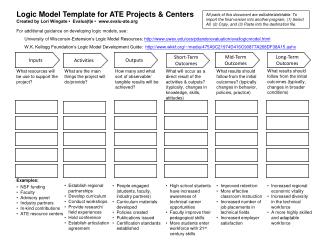
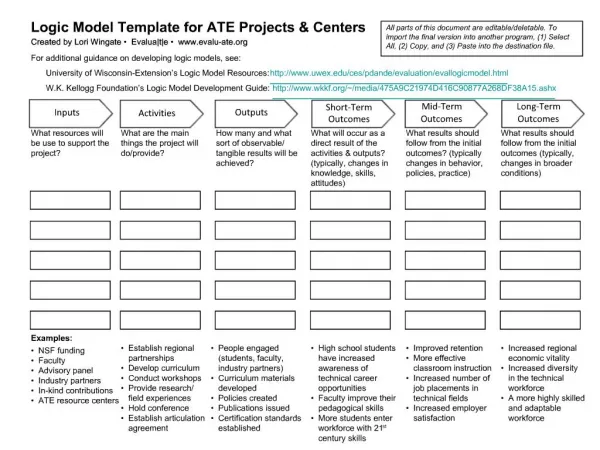
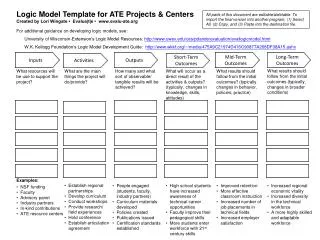
This editable Logic Model Template, created by Lori Wingate for ATE (Advanced Technological Education) projects and centers, serves as a guide for project planners. It outlines essential components including Inputs, Outputs, Activities, Short-Term Outcomes, Mid-Term Outcomes, and Long-Term Outcomes. By utilizing this template, project leaders can visualize and strategize their initiatives to enhance effectiveness, engage stakeholders, and track progress toward measurable results. For additional resources on developing logic models, refer to the provided links from the University of Wisconsin-Extension and W.K. Kellogg Foundation.

Comprehensive Logic Model Template for ATE Projects and Centers
E N D
Presentation Transcript
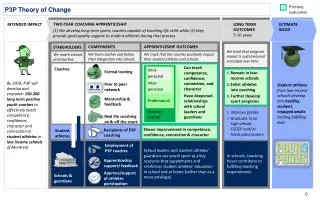
Logic Model Template for ATE Projects & Centers Created by Lori Wingate • Evalua|t|e • www.evalu-ate.org All parts of this document are editable/deletable. To import the final version into another program, (1) Select All, (2) Copy, and (3) Paste into the destination file. For additional guidance on developing logic models, see: University of Wisconsin-Extension’s Logic Model Resources: http://www.uwex.edu/ces/pdande/evaluation/evallogicmodel.html W.K. Kellogg Foundation’s Logic Model Development Guide: http://www.wkkf.org/~/media/475A9C21974D416C90877A268DF38A15.ashx Inputs Outputs Mid-Term Outcomes Long-Term Outcomes Activities Short-Term Outcomes What results should follow from the initial outcomes (typically, changes in broader conditions) What resources will be use to support the project? What are the main things the project will do/provide? How many and what sort of observable/ tangible results will be achieved? What will occur as a direct result of the activities & outputs? (typically, changes in knowledge, skills, attitudes) What results should follow from the initial outcomes? (typically changes in behavior, policies, practice) Examples: • Establish regional partnerships • Develop curriculum • Conduct workshops • Provide research/ field experiences • Hold conference • Establish articulation agreement • People engaged (students, faculty, industry partners) • Curriculum materials developed • Policies created • Publications issued • Certification standards established • High school students have increased awareness of technical career opportunities • Faculty improve their pedagogical skills • More students enter workforce with 21st century skills • Improved retention • More effective classroom instruction • Increased number of job placements in technical fields • Increased employer satisfaction • Increased regional economic vitality • Increased diversity in the technical workforce • A more highly skilled and adaptable workforce • NSF funding • Faculty • Advisory panel • Industry partners • In-kind contributions • ATE resource centers