Biotechnology
This educational module explores the essentials of genetic engineering and recombinant DNA technology. It covers the structures and functions of DNA, RNA, and proteins, as well as how genetic alterations can produce new traits in organisms, impacting agricultural and biomedical fields. Students will learn how exogenous DNA can be inserted into bacterial cells, leading to the expression of novel proteins. Key topics include transgenic organisms, the role of plasmids and restriction enzymes, and the production of recombinant DNA. This knowledge aids in understanding biotechnology's applications in everyday life, from medicine to food production.

Biotechnology
E N D
Presentation Transcript
Biotechnology Part II. Genetic Engineering and Recombinant DNA
Content Standards • 5a.Students know the general structures and functions of DNA, RNA, and protein. • BI5. c. Students know how genetic engineering (biotechnology) is used to produce novel biomedical and agricultural products. • 5e.* Students know how exogenous DNA can be inserted into bacterial cells to alter their genetic makeup and support expression of new protein products.
Objectives: SWBAT • explain the structure and function of DNA, RNA, and proteins. • predict the physical characteristics of an organism based on its genetic make up. • understand the general pathway by which ribosomes make proteins. • understand how altering an organisms genetic make-up changes the proteins the organism produces.
Genetics Review • Genes code for proteins (transcription and translation) • Proteins-make-up physical characteristics • Changes in the DNA sequence will affect the genetic code (mutations) • If the genetic code is changed then a protein can be changed • This can change an organisms’ physical characteristics
How is Biotechnology a part of your life? • Medical research • Consumer products (clothing) • Forensic Science (crime scene investigation) • Maury (paternity tests) • Genetically modified foods (you eat them on a daily basis)
What is Biotechnology? • Bio=life • Technology=usage and knowledge of tools and crafts • Biotechnology- technology that uses biological systems, living organisms, or products made from living organisms to make or modify products or processes for specific use
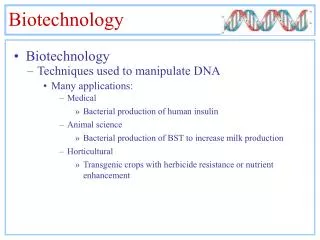
What is genetic engineering? • Altering genes to produce a protein • Changing of an organism’s DNA to give the organism new traits • Transgenic organisms-has one or more genes from another organism inserted into its genome • Uses-medication and genetically modified crops
What are plasmids and restriction enzymes? • BacterialPlasmids-circular pieces of DNA, found in bacteria • Restriction enzymes-enzymes that cut DNA at specific sites • Restriction sites-sections of DNA recognized by restriction enzymes as the place to “cut” the DNA (BamH I, Hind III )
How are recombinant DNA molecules produced? • Recombinant DNA-DNA sequence that is produced from combining DNA sequences, contains more than one organisms genes • RE-used to cut out desired gene from DNA • Plasmids are cut with same RE • Plasmid opens and gene is added to plasmid • Sticky ends of DNA are bonded together (ligation)
restriction analysis of pKAN-R and pARA pKAN-R 5408 bp BamH I rfp 702 bp pARA 4058 bp Hind III BamH I Hind III 40 bp
BamH I sticky end Hind III sticky end Hind III sticky end BamH I sticky end ligation of pKAN-R/pARA restriction fragments
Summary Questions • What are some beneficial uses of transgenic organisms? • How are recombinant DNA molecules produced? (describe this process in detail)