
Cell Structure and Function
E N D
Presentation Transcript
The cell theory grew out of the work of many scientists and improvements in the microscope. • Many scientists contributed to the cell theory. • More was learned about cells as microscopes improved.
The cell theory grew out of the work of many scientists and improvements in the microscope. • Many scientists contributed to the cell theory. • More was learned about cells as microscopes improved. • The cell theory is a unifying concept of biology.
Early studies led to the development of the cell theory. • The Cell theory has three principles. • All organisms are made of cells.
Early studies led to the development of the cell theory. • The Cell theory has three principles. • All organisms are made of cells. • All existing cells are produced by other living cells.
Early studies led to the development of the cell theory. • The Cell theory has three principles. • All organisms are made of cells. • All existing cells are produced by other living cells. • The cell is the most basic unit of life.
Prokaryotes • Genetic material is not in a nucleus • Less complicated and smaller than eukaryotic cell • Example: Bacteria **An organism made of a prokaryotic cell is called a prokaryote.
Eukaryotes • Genetic material is contained in a nucleus and separated from the rest of the cell • More complex and larger than prokaryotic cells • Example: Plants, animals, fungi, protists **An organism made of eukaryotic cell(s) is called a eukaryote.
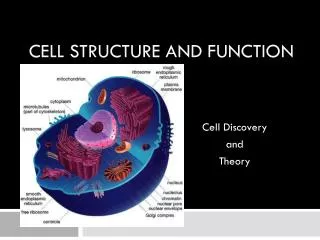
Eukaryotic cellstructure • Two major parts: • Nucleus • Cytoplasm-portion of the cell outside the nucleus that contains organelles (parts or “organs” of the cell)
Nucleus-The control center • Structure: • Surrounded by a double membrane called a nuclear envelope. It is dotted with many nuclear pores to allow materials (RNA, proteins, etc) in and out of the nucleus.
Nucleus • Function: • Contains almost all of the cell’s DNA for coding proteins and other molecules. • DNA is found on chromosomes which contain genetic information. • The Control Center of the cell!
Nucleolus • Structure: • Small dense region in the center of the nucleus Function: • where ribosomes are made.
Ribosomes • Structure: • Small pieces of RNA and protein found throughout the cell. • Two subunits. • Function: • Site of protein synthesis.
Rough Endoplasmic Reticulum • Structure: • Membranous system • Rough ER- has ribosomes on surface to assemble proteins • Continuous with the nuclear envelope • Function: • Site where lipid parts of cell membrane are made, along with proteins and other materials to export from the cell.
Smooth Endoplasmic Reticulum • Structure: • Membranous system • NO ribosomes on surface • Function: Synthesis of lipids and phospholipids for membranes Detoxifies drugs and toxins in the cell
Golgi Apparatus • Structure: • Stack of closely packed membranes • Function: • Modify, sort, and package proteins and other materials from the ER for storage in the cell or release from the cell. It puts the finishing touches on proteins.
Lysosomes • Structure: • Small sac, filled with digestive enzymes • Function: • Breakdown of lipids, carbohydrates and proteins into small molecules to be used by the rest of the cell • Breakdown used up organelles • Gets rid of all “stuff” in the cell • The “Clean-up crew”
Vacuole • Structure: • Sac-like • Plant cells have one large central vacuole • Animal cells have many small vacuoles • Function: • Stores water, salts, proteins and carbohydrates
Mitochondria • Structure: • Enclosed by two membranes with the inner folded membrane, called cristae. • Contains it’s own DNA (Evidence for the Endosymbiotic Theory) • Function: • Convert chemical energy in food into materials easier for the cell to use. This is called cell respiration.
Chloroplasts Structure: • Surrounded by two membranes • Stacks of membranes inside called thylakoids. • Contains own genetic information like mitochondria • Contains green pigment called chlorophyll • Not found in animal cells! • Function: • Captures energy from the sun (solar energy) and changes it into food (chemical energy) for plants (photosynthesis).
The History of the cell continued • In 1967, Lynn Margulis proposed that mitochondria and chloroplasts were descended from ancient symbiotic prokaryotes.This theory is called the Endosymbiotic Theory! Click on image to view video
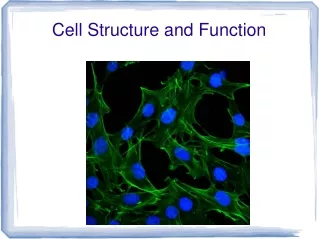
Cytoskeleton- structure and support • Structure: • Two types: microfilaments and microtubules- made of proteins Function: • Helps maintain cell shape • Helps with movement of the cell (i.e. flagella and cilia)
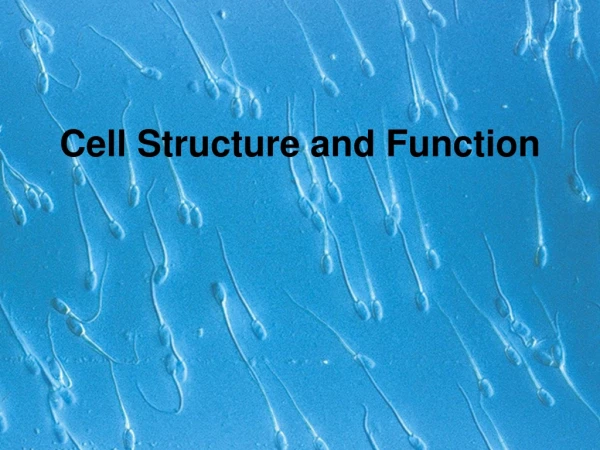
Flagellum • Structure: • long, whip-like structure made of microtubules • Function: • Allows the cell to swim through fluid
Cilia • Structure: • small hair-like structures made of microtubules; beat rhythmically to move fluid outside the cell. • Function: • This propels or anchors the cell.
Centrioles • Structure • Pair of cylindrical arrangement of microtubules found perpendicularly to each other • Region around centrioles called centrosome • Function • help Divide the DNA in ANIMAL CELL division
Cell Membrane • Structure: • Double membrane called a lipid bilayer • Flexible structure that forms a strong barrier between the cell and its surroundings • Phospholipids with integral proteins and cholesterol Function: • Regulates what enters and leaves the cell • Provides protection and support
Cell Wall • Structure: • Lies outside the cell membrane • Made of structural carbohydrates • Found in plants, algae, fungi and many bacteria • NOT FOUND IN ANIMAL CELLS! • Function: • Provides support and protection for the cell
Levels of organization(smallest to largest) 1. Cells 2. Tissues: group of similar cells with specific function • Four types: muscle, epithelial, nervous, connective tissue 3. Organs: groups of tissues working together 4. Organ systems: a group of organs that work together to perform a specific function • Examples: Nervous system, digestive system