
SlideServe
Menu
Préférences
© SlideServe · v2026

Martha Stewart

min avatar
18 diapositives · 606 Views · Jul 14, 2014

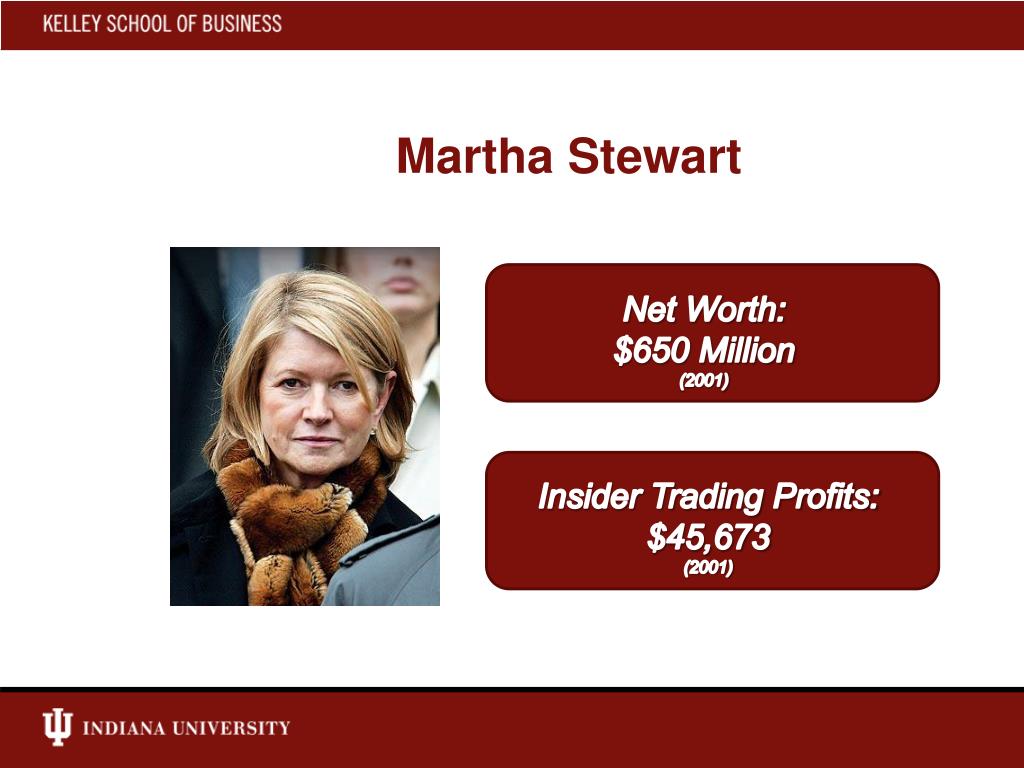
Martha Stewart. Net Worth: $650 Million (2001). Insider Trading Profits: $45,673 (2001). Don Tyson. Net Worth: Forbes Top 1,000 Richest Americans (1992). Insider Trading Profits: $46,125 (1992). Mark Cuban. Net Worth: $1.3 Billion (2004).
Martha Stewart - slide 1
01 / 18Martha Stewart
1 / 17

Télécharger la présentation

Martha Stewart
Une image / un lien ci-dessous est fourni (tel quel) pour télécharger la présentation

Politique de téléchargement : le contenu du site vous est fourni TEL QUEL pour votre information et votre usage personnel ; il ne peut être vendu, concédé sous licence ni partagé sur d’autres sites sans l’accord de son auteur.Le contenu vous est fourni TEL QUEL, pour votre information et votre usage personnel uniquement. Téléchargez la présentation en cliquant sur ce lien. Lors du téléchargement, si vous ne parvenez pas à télécharger une présentation, l’éditeur a peut-être supprimé le fichier de son serveur.Pendant le téléchargement, si vous ne parvenez pas à obtenir une présentation, le fichier a peut-être été supprimé par l’éditeur.

F I N

Plus de contenu associé

Transcription de la présentation
  1. Martha Stewart Net Worth: $650 Million (2001) Insider Trading Profits: $45,673 (2001)

  2. Don Tyson Net Worth: Forbes Top 1,000 Richest Americans (1992) Insider Trading Profits: $46,125 (1992)

  3. Mark Cuban Net Worth: $1.3 Billion (2004) Insider Trading Profits: $750,000 (2004)

  4. Do They Do It for the Money? Utpal Bhattacharya Cassandra Marshall CSEF-IGIER Symposium Capri, Italy June 23, 2010

  5. Cassandra Marshall

  6. Gary Becker American Economist and Nobel Laureate Economic Motive for Crime

  7. Fyodor Dostoevsky Russian Author (1821-1881) • Psychological Motives for Crime • Psychobiological Theories • Biochemical and Neurological Theories • Psychoanalytic and Psychodynamic Theories • Learning Theories • Cognitive Theories

  8. Edwin Sutherland President of the American Sociological Society in 1939 (1883-1950) Sociological Motive for Crime

  9. Null Hypothesis If the motivation for illegal insider trading is economic, we should see the “poorer” top management being convicted, controlling for the opportunities for insider trading.

  10. Data • SEC Litigation Releases of individuals convicted of insider trading in the United States from September 1995 through December 2004 (576 releases) for trades during 1989-2002 • Firms in which top management was convicted of insider trading (41 firms) • Control Group: All other firms in Compustat during the insider trading years (169,825 firm/years) – Table 1

  11. Data (Continued) • Top management convicted of insider trading with compensation available (52 individuals, 41 firms) • Control Group: All other executives in a matched sample of Compustat firms (matched by year, industry, size, and title) – Table 2. All other executives in other Execucomp firms – Tables 3, 4, 5 • Top management convicted of insider trading with compensation who trade on M&A information (9 individuals, 9 firms) • Control Group: All other executives in Execucomp during the insider trading years whose firm was involved in a Merger or Acquisition in SDC (101,188 individual/firm/years) – Tables 6 and 7

  12. Are the firms different?

  13. Are the top managers poorer?(NOT controlling for benefits)(Table 3 Probit: Y=1 for convicted inside trader)

  14. Are the top managers poorer?(NOT controlling for benefits)(Table 4 Rare Events Logit: Y=1 for convicted inside trader)

  15. Are the top managers poorer?(NOT controlling for benefits)(Table 5 IV Probit: Y=1 for convicted inside trader)

  16. Are the top managers poorer?(Controlling for benefits)(Table 6 Probit: Y=1 for convicted inside trader)

  17. Are the top managers poorer? (Controlling for benefits)(Table 7 Rare Events Logit: Y=1 for convicted inside trader)

  18. Conclusion • So, do they do it for the money? • Maybe, but it does not seem to be an important reason • Then why do they do it? • We leave that for future research • Possible Motives: • Psychological (e.g.,Hubris) • Sociological (e.g.,Company Culture) • You tell me