Download
1 / 21
210 likes | 333 Vues
This exploration delves into the concept of passion in theatre, tracing its evolution from ancient Greek performances to contemporary stagecraft. Initially emerging from Dionysian festivals, Greek theatre introduced groundbreaking techniques such as the use of masks, solo actors, and dialogue through the innovations of Thespis, Aeschylus, and Sophocles. In contrast, modern theatre emphasizes realism and method acting, where actors draw from personal emotions to bring characters to life. This journey showcases the enduring significance of passion as a driving force behind compelling performances.

E N D
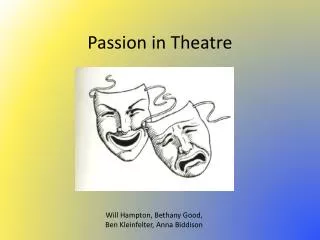
Passion in Theatre Will Hampton, Bethany Good, Ben Kleinfelter, Anna Biddison
Passion: A Definition An overwhelming rush of emotion that leads to uncontrollable actions; similar to an “out-of-body experience.”
Ancient Greek Theatre • Theatre originally evolved from the festivals related to Dionysus, the Greek god of fertility and wine. • Aristotle's Poetics contain the earliest known theory about the origins of Greek theatre.
Thespis In the 500s B.C., Thespis created a new style in which a solo actor performed the speeches of the different characters • He accomplished this by using masks to distinguish between the different characters • He is considered the first Greek “actor” • Thespis’ new style subsequently became part of the official celebrations of the Dionysian festival • In 534 B.C., annual competitions for the best tragedy were instituted at the City Dionysia in Athens • His style of theatre became known as the tragedy (meaning “goat song”, referring to goats sacrificed to Dionysus before performances)
Aeschylus and Sophocles • In 471 B.C., the dramatist Aeschylus innovated a second actor, thus making dialogue between characters possible onstage. • Around 468 B.C., Sophocles introduced a 3rd actor making more complex dramatic situations possible. This set of actors became the norm. • Later, plays depicted stories of all of Greek mythology, rather than just Dionysus
Aeschylus and Sophocles (cont’d.) Aeschylus Sophocles
Euripedes • Last of the three great tragedians of Greek theatre • Portrayed strong female characters and satirized the Greek mythology • Focused on the inner lives and motives of his characters in a way previously unseen in Greek theatre
Passion in Greek Theatre • Greek theatres were often very large so Greek actors had to be very elaborate when demonstrating any emotion
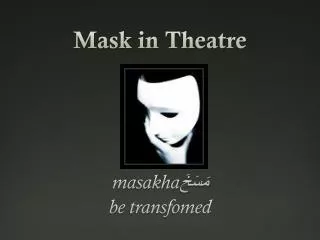
Masks in Greek Theatre Greek actors wore very intricate masks to exemplify a certain emotion of a certain character
Elizabethan Theatre • Dates back to the European Renaissance Theatre in the 16th-17th Century. • Origins include England and Italy right after the Reformation • Started out as mysteries that had religious meaning under the control of the Church • However, theatre then became a medium of folk entertainment with the development of comedy
Modern Theatre • Originally, there were no permanent actors • Dramatic plays grew in popularity • Men first played the roles of women • Shakespeare turned theatre into a very complex structure, vastly increasing its popularity • By the 1800s, theatre became a very profitable business and the theatre in that age is the theatre we see today
Modern Theatre (cont’d.) • In the early 1900s, realism became the mainstream style in theatre • Theatre Guild lead to increased competition between foreign and domestic works • Drama becomes widespread at universities • Now, in the 21st Century, there is a general trend towards more controversial topics such as gay rights, epidemics, corrupt government, etc.
Passion In Modern Theatre • The key to portraying passion in modern theatre is trying to recreate real life as closely as possible
Method Acting • Method acting is a technique in which actors create a very lifelike performance by becoming one with their character • The actors draw upon their own emotions and memories in their portrayal while also doing exercises to strengthen sensory memory • Many people think that method actors continue to portray their characters offstage; however, this is a popular misconception.
Method Acting (cont’d.) • When an actor/actress utilizes the technique of method acting the line between the actor’s personality and the character’s personality is often blurred. • Some examples of famous method actors are Robert de Niro, Marlon Brando, and Heath Ledger
Method Acting: The Controversy • Recently, there has been some debate as to whether or not actors/actresses are expressing genuine passion or whether it is faked. • Also, the association of emotions with certain scenes can often be unpredictable as emotions are volatile and unstable
Method Acting: Controversy (cont’d.) • Whether or not one dons “the Method” as their approach, the quest for emotional truth in performance is still viable today. Many actors use method techniques, consciously or not. • Joker Scene from Batman http://www.youtube.com/watch?v=37zErAXOx-A&feature=fvw
Works Cited • http://www.modern-theatre.com/ • http://novaonline.nvcc.edu/eli/spd130et/modern-theatre.htm • http://en.wikipedia.org/wiki/Theatre_of_ancient_Greece • http://www.crystalinks.com/greektheater.html • http://www.youtube.com/watch?v=37zErAXOx-A&feature=fvw • http://novaonline.nvcc.edu/eli/spd130et/modern-theatre.htm • Google/Wikipedia Images