Understanding Network Delays and Statistical Multiplexing in Data Transmission
This discussion explores key concepts of transmission and propagation delays within network systems, particularly focusing on the interaction between hosts and switches. It analyzes critical components such as transmission delay, which is influenced by physical distance and link bandwidth, as well as queuing delay associated with packet transfer. The concept of statistical multiplexing is examined, emphasizing oversubscription and its expected performance under average traffic conditions. Various animations illustrate data rates and capacities to aid comprehension of network performance dynamics.

Understanding Network Delays and Statistical Multiplexing in Data Transmission
E N D
Presentation Transcript
Network Delays, Statistical Multiplexing EE 122 Discussion 9/12/11
Transmission and Propagation Delay Host 1 Switch 1 Propagation delay between Host 1 and Switch1 Speed of light Physical distance Transmission delay Size of transfer Bandwidth of link
Queuing Delay (Problem #3) A C B Transmission delay doubles Brown packet waits for half the trans. delay of blue packet
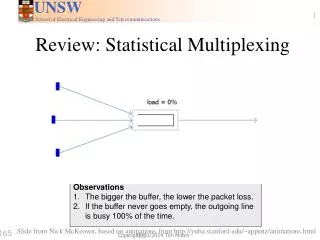
Statistical Multiplexing • Over-subscribe “peak” requirements of flows and hope that “average” requirements are under capacity • “Hope is a good thing, maybe the best of things…”
Animation from class Data Rate 1 Time Data Rate 2 Capacity Time Data Rate 3 Time
Animation from class Data Rate 1 Time Data Rate 2 Capacity / 3 Capacity / 3 Time Capacity / 3 Data Rate 3 Time
Animation from class Time Below capacity of link all the time! Time Time
Why and when will this work? Zone #2 Zone #1 Zone #3 • Probability of a flow transmitting in each time zone is 1/3 • What is the expected value of the overall flow? Time Time Time