
SlideServe
Menu
Préférences
© SlideServe · v2026

Empowering Clubs to Drive Successful Humanitarian Projects

mulan avatar
20 diapositives · 335 Views · Jul 12, 2014

Discover how to ignite your passion and take responsibility for impactful humanitarian projects in your Rotary club. Start by engaging with your club president for support, conducting thorough research on available resources, and attending project workshops. Learn to identify sustainable project opportunities and build lasting community partnerships. Ensure the projects appeal to both heart and mind, and focus on measurable outcomes. Ultimately, enjoy the process of collaboration, friendship, and making a difference in people's lives. Together, we can achieve more!
Empowering Clubs to Drive Successful Humanitarian Projects - slide 1
01 / 20Empowering Clubs to Drive Successful Humanitarian Projects
1 / 17

Télécharger la présentation

Empowering Clubs to Drive Successful Humanitarian Projects
Une image / un lien ci-dessous est fourni (tel quel) pour télécharger la présentation

Politique de téléchargement : le contenu du site vous est fourni TEL QUEL pour votre information et votre usage personnel ; il ne peut être vendu, concédé sous licence ni partagé sur d’autres sites sans l’accord de son auteur.Le contenu vous est fourni TEL QUEL, pour votre information et votre usage personnel uniquement. Téléchargez la présentation en cliquant sur ce lien. Lors du téléchargement, si vous ne parvenez pas à télécharger une présentation, l’éditeur a peut-être supprimé le fichier de son serveur.Pendant le téléchargement, si vous ne parvenez pas à obtenir une présentation, le fichier a peut-être été supprimé par l’éditeur.

F I N

Plus de contenu associé

Transcription de la présentation
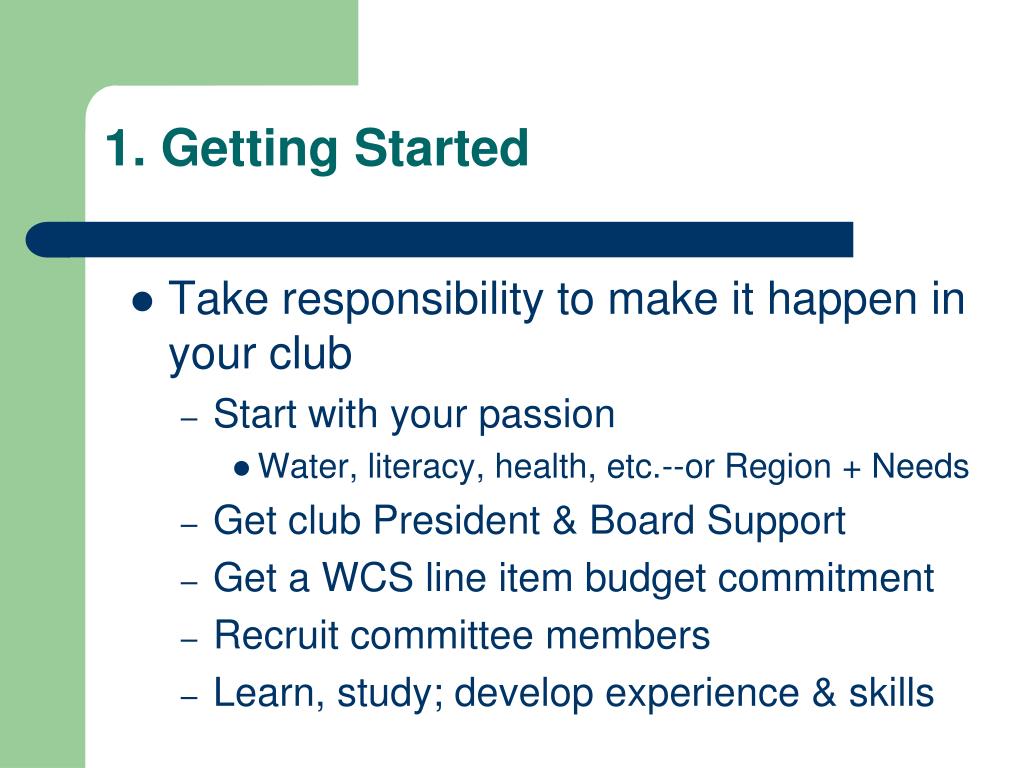
  1. 1. Getting Started Take responsibility to make it happen in your club Start with your passion Water, literacy, health, etc.--or Region + Needs Get club President & Board Support Get a WCS line item budget commitment Recruit committee members Learn, study; develop experience & skills

  2. 2. Do Some Basic Homework • Read about Humanitarian Service on www.Rotary.organdD5100WCS.orgincluding: • Guide to Matching Grants (form 141en at www.Rotary.org/RIdocuments) http://bit.ly/I7Nh7s • Study the booklets, forms, spreadsheets & checklist on our District 5100 website • D5100WCS.org • Imagine you lived in the village … how would you assess, prioritize & begin to meet needs?

  3. 3. Attend Our Project Exchanges/Workshops • District Level: Every 3rd Wednesday at the District Office in Wilsonville • 4:00-5:30 PM • Ask to be on Pmail list • RonK@theHGroup.com • K.Stromvig@comcast.net (after June 30) • Attend a successful club’s International Service committee meeting • List available on our website

  4. 4. Finding a Project--1 • Team up with a project underway with another club in our district • $500 to $5,000 • Come to our monthly exchanges, read pmail, notes • Call clubs … collaborate • Find available projects: D5100WCS.org, MatchingGrants.org, ProjectLink and Wasrag.org • Homework & due diligence is always required

  5. 4. Finding a Project--2 • Use existing connections & relationships: • Y.E. & G.S.E. • Friendship Exchange • Personal travel, International Business • Project Fairs – in person or electronic • Partners in Service • RAGM.org … Wasrag.org … other RAGs

  6. 5. What do we mean Sustainable? • Deliverable/benefit lasts indefinitely; for a lifetime • TRF Definition: Sustainability is the capacity for maintaining outcomes long‐term to serve the ongoing need of a community after grant funds have been expended. • Essential elements of sustainability: • technical solution, issues • social & cultural factors • financial & business-like elements • empowerment & community self-sufficiency • some examples … Key concept in Upcoming Vision

  7. Needs  Assist  Sustainability • Slow, Reduce: • “1 of” Projects • Donor-dependency • Supply- or Grant-driven • Think, Identify & Use: • Community Solutions • Empowerment • Use alternatives with • Local materials, jobs, manufacture, skills • Vision & Path to Future • Monitor, Measure • Evaluate & Learn

  8. 6. Other Elements of Successful Project • Appeals to Hearts & Head (greatly improves human condition) • Reliable long-term partner (reputation, checklist) • Community & members volunteerism, commitment • Meets Area of Focus, Terms & Conditions • Fiscally sound, with stewardship process • Optimizes use of $$ (aka “bang for buck”)

  9. 6. Other Elements of Success (cont’d) • Measurable Outcome – Evaluate it • Repeatable, Growable, Generalizeable • Adopt-a-village, -area, -watershed, -country • Add-in features (WaSH > stoves; School > literacy, compost>crops, microlending>enterprise) • follow community lead on needs, priorities • Plan to visit, to share, to promote ... to celebrate ... and repeat. Be infectious!

  10. 7. Resources: • RI Communities In Action booklet 605a & RI Community Assessment Tools 605c • Rotary.org – Future Vision materials, training • FV Resources page http://bit.ly/Il8sgP • Vocation Training Teams (VTT) can support International & Vocational service • TRF Performance Enhancement Program • Wasrag  other RAGs and Areas of Focus

  11. 8. Have Fun! It’s not only the end product of the project, and all the good it may do … Also about the process and friendships you build along the way. Collaborate - do more than you could ever do on your own!

  12. Thank You! Ron Kelemen RonK@TheHgroup.com www.D5100WCS.ORG Stew Martin StewMartin@Nehalemtel.net