Optimizing Performance: Multicycle vs. Single Cycle MIPS Implementation
Explore the efficiency between multicycle and single cycle MIPS implementations, control for new instructions, Amdahl's Law, and performance examples. Determine speedup and CPI calculations.


Optimizing Performance: Multicycle vs. Single Cycle MIPS Implementation
E N D
Presentation Transcript
Single Cycle MIPS Implementation • All instructions take the same amount of time • Signals propagate along longest path • CPI = 1 • Lots of operations happening in parallel • Increment PC • ALU • Branch target computation • Inefficient
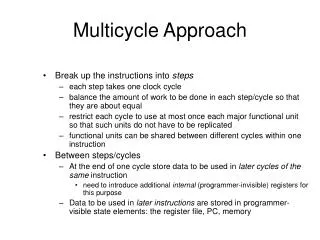
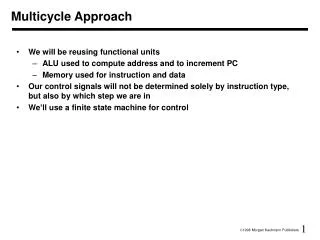
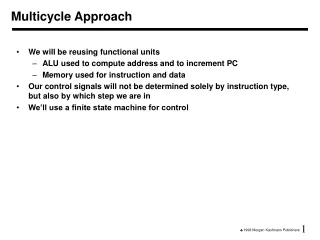
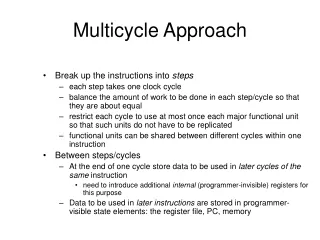
Multicycle MIPS Implementation • Instructions take different number of cycles • Cycles are identical in length • Share resources across cycles • E.g. one ALU for everything • Minimize hardware • Cycles are independent across instructions • R-type and memory-reference instructions do different things in their 4th cycles • CPI is 3,4, or 5 depending on instruction
Multicycle versions of various instructions • R-type (add, sub, etc.) – 4 cycles • Read instruction • Decode/read registers • ALU operation • ALU Result stored back to destination register. • Branch – 3 cycles • Read instruction • Get branch address (ALU); read regs for comparing. • ALU compares registers; if branch taken, update PC
Multicycle versions of various instructions • Load – 5 cycles • Read instruction • Decode/read registers • ALU adds immediate to register to form address • Address passed to memory; data is read into MDR • Data in MDR is stored into destination register • Store – 4 cycles • Read instruction • Decode/read registers • ALU adds immediate to a register to form address • Save data from the other source register into memory at address from cycle 3
Control for new instructions • Suppose we introduce lw2r: • lw2r $1, $2, $3: • compute address as $2+$3 • put result into $1. • In other words: lw $1, 0($2+$3) • R-type instruction • How does the state diagram change?
Control for new instructions • Suppose we introduce lw2r: • lw2r $1, $2, $3: • compute address as $2+$3 • Load value at this address into $1 • In other words: lw $1, 0($2+$3) • R-type instruction • How does the state diagram change? • New states: A,B,C • State 1 (op=‘lw2r’) State A State B State C back to 0 • A controls: ALUOp=00, ALUSrcA=1, ALUSrcB=0 • B controls: MemRead=1, IorD = 1 • C controls: RegDst = 1, RegWrite = 1, MemToReg = 1
Performance • CPI: cycles per instruction • Average CPI based on instruction mixes • Execution time = IC * CPI * C • Where IC = instruction count; C = clock cycle time • Performance: inverse of execution time • MIPS = million instructions per second • Higher is better • Amdahl’s Law:
Performance Examples • Finding average CPI:
Performance Examples • Finding average CPI: • CPI = 0.50*2 + 0.08*2 + 0.08*3 + 0.34*1 CPI = 1.74
Performance Examples • CPI = 1.74 • Assume a 2GHz P4, with program consisting of 1,000,000,000 instructions. • Find execution time
Performance Examples • CPI = 1.74, 2GHz P4, 10^9 instructions. • Execution_time = IC * CPI * Cycletime = 10^9 * 1.74 * 0.5 ns = 0.87 seconds
Performance Examples • We improve the design and change CPI of load/store to 1. • Speedup assuming the same program?
Performance Examples • We improve the design and change CPI of load/store to 1. • Speedup assuming the same program/cycle time? • CPInew = 0.5*1 + 0.08*2 + 0.08*3 + 0.34*1 CPInew = 1.24 • Speedup = 1.74/1.24 = 1.4
Amdahl’s Law • Suppose I make my add instructions twice as fast. • Suppose 20% of my program is doing adds • Speedup? • What if I make the adds infinitely fast?
Amdahl’s Law • Suppose I make my add instructions twice as fast. • Suppose 20% of my program is doing adds • Speedup? New Exectime = old_exectime(4/5 + (1/5)/2) = 9/10 * old_exectime Speedup = 10/9 • What if I make the adds infinitely fast? Speedup = 5/4, only 20% improvement!
Multicycle performance example • Multicycle can have better performance than single cycle • Instructions take only as many cycles as they need • CPI Example • Loads: 5, stores: 4, R-type: 4, branches: 3 • % of total instructions: loads: 22%, stores: 11%, R-type: 50%, branches: 17% • Same # of instructions for single cycle and multicycle! • CPIsingle= 1 • but each cycle of Msingle is equivalent to 5 cycles of Mmulti • So effectively, CPIsingle = 5 for this comparison • CPImulti = 5*.22 + 4 * .11 + 4 * .50 + 3 * .17 = 4.05 • Speedup = 5/4.05 = 1.2