
Ch. 2 – Scientific Method
E N D
Presentation Transcript
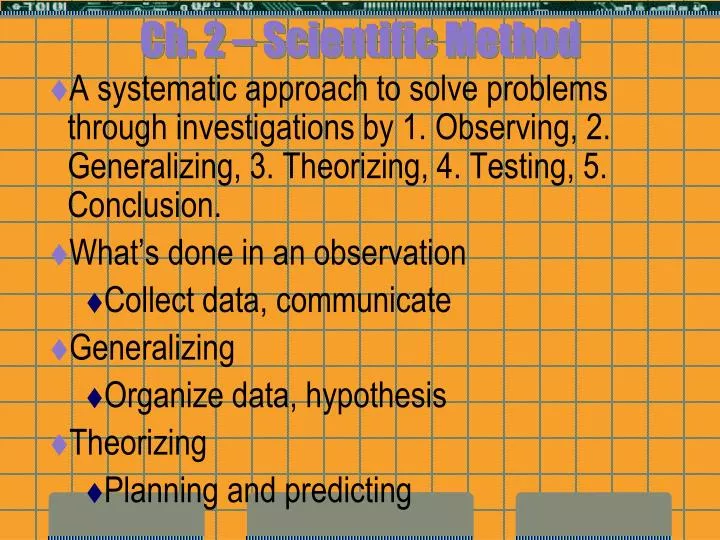
Ch. 2 – Scientific Method • A systematic approach to solve problems through investigations by 1. Observing, 2. Generalizing, 3. Theorizing, 4. Testing, 5. Conclusion. • What’s done in an observation • Collect data, communicate • Generalizing • Organize data, hypothesis • Theorizing • Planning and predicting
Test • Design experiment, test, graph and interpret results • Conclusion • May change hypothesis and retest • Explain what happened in your results
Measurements • Why do we need measurements? • If I told you to go get me a pop would you know what size? • The International System of Units (SI) is used throughout the world so we don’t confuse figures and measurements. • SI is metric • Written the following way: 21 400 or 0.157 82 • 7 SI fundamental units Mass, time, temperature, length, amount of substance. Pg. 34
SI Unit Prefixes • Unit of measurements for length • KHDMDCM • Kilo, hecto, deka, meter, deci, centi, milli • Ex. Kilogram (1000 grams) or Kilometer (1000 meters) • 1 gram is about 1 pencil mass • Your book is about 2 Kg • Derived Unit – are combinations of fundamental units.
Derived Units • Area length X width (m2) • Volume length X width X height (m3) • Volume is the amount of space occupied by an object. • 1ml = 1cm3 • 1 liter = 1000-ml • 1 ml = how many liters? • Density is mass divided by volume (D=m/v) • How heavy something is for its size. • Ex. Pg. 38 (Density Lab)
Temperature is the measure of the average kinetic energy of the particles in a sample of matter. • What is the SI unit for temp.? • Kelvin (K) • Heat is the sum of the kinetic energy of the particles in a sample of matter. • How does a thermometer work? • We use Celsius more than Kelvin • 0 C = 273 K – freezing point • 100 C = 373 K- boiling point
Joule is force times length (f X l) • 1 J = 1 n-m • Joule is the SI unit for energy • A calorie is the amount of heat needed to raise the temperature of 1 g of water 1 degrees C. • 1 calorie = 4.184 J • Kcal or C = KJ • Food Calories are kilocalories. • Conversion Factors – Sample Problem 2-2
Specific heat is the amount of heat energy required to raise the temp. of 1 g of a substance 1 degree C. • Label is J/(g x C) • Water heats up and cools down slowly, thus it has a high specific heat. • Accuracy vs. Precision • Accuracy is determined by how close your results are to the correct answer. • Precision is determined by how close your results are to each other. • Ex. Dart Board – pg. 44 • Sample Problem 2-3 (Percent Error)
SIGNIFICANT FIGURES • Significant figures are all the digits known with certainty plus one final digit, which is uncertain or estimated. • Read pg. 46 – bottom 2 paragraphs • Read pg. 47 – Table 2-5 • Do Sample Problems on pg. 47 & 48 • Rounding off Addition & Subtraction Problems • Rounding off Multiplication & Division Problems
Scientific Notation • This is very helpful to determine the correct number of significant figures. • Ex. 50 890 5.089 X 10⁴ • Ex. 0.005031 5.031 X 10⁻³ • Ex. 74 621 000 7.462 1 X 10⁷ • Using Adding & Subtracting Scientific Notation • Using Multiplying & Dividing Scientific Notation