
SlideServe
Menu
Préférences
© SlideServe · v2026

Mutualism

nelia avatar
11 diapositives · 322 Views · Jul 24, 2014

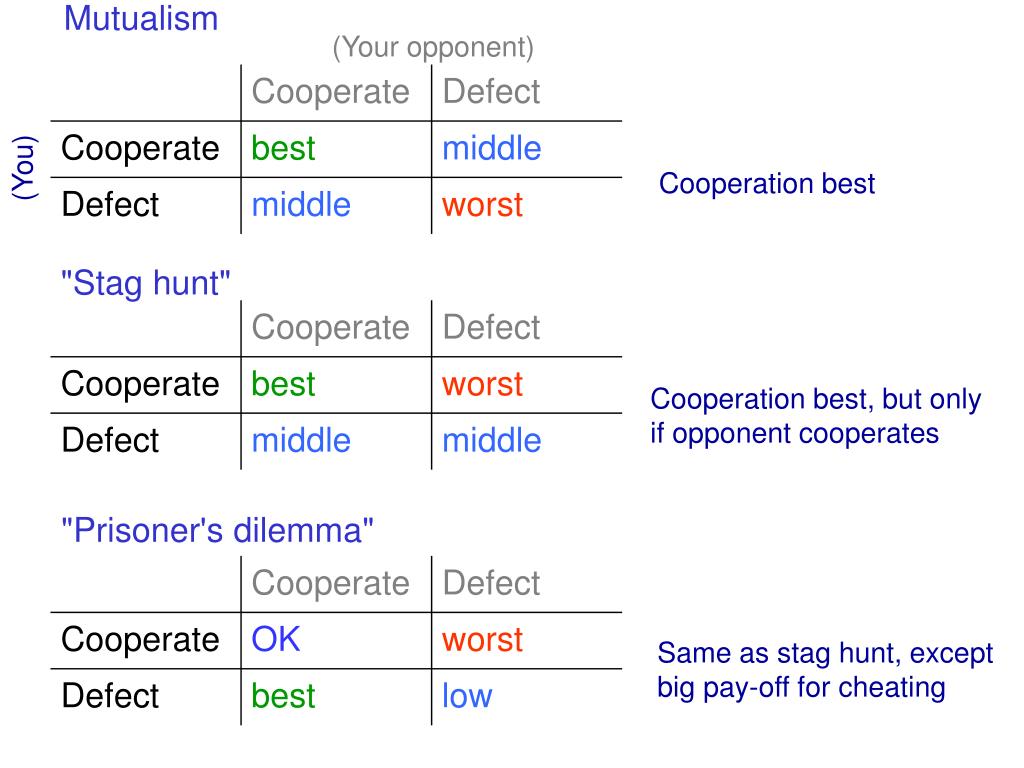
Mutualism. (Your opponent). (You). Cooperation best. "Stag hunt". Cooperation best, but only if opponent cooperates. "Prisoner's dilemma". Same as stag hunt, except big pay-off for cheating. "Stag hunt". Cooperation best, but only if opponent cooperates. "Prisoner's dilemma".
Mutualism - slide 1
01 / 11Mutualism
1 / 17

Télécharger la présentation

Mutualism
Une image / un lien ci-dessous est fourni (tel quel) pour télécharger la présentation

Politique de téléchargement : le contenu du site vous est fourni TEL QUEL pour votre information et votre usage personnel ; il ne peut être vendu, concédé sous licence ni partagé sur d’autres sites sans l’accord de son auteur.Le contenu vous est fourni TEL QUEL, pour votre information et votre usage personnel uniquement. Téléchargez la présentation en cliquant sur ce lien. Lors du téléchargement, si vous ne parvenez pas à télécharger une présentation, l’éditeur a peut-être supprimé le fichier de son serveur.Pendant le téléchargement, si vous ne parvenez pas à obtenir une présentation, le fichier a peut-être été supprimé par l’éditeur.

F I N

Plus de contenu associé

Transcription de la présentation
  1. Mutualism (Your opponent) (You) Cooperation best "Stag hunt" Cooperation best, but only if opponent cooperates "Prisoner's dilemma" Same as stag hunt, except big pay-off for cheating

  2. "Stag hunt" Cooperation best, but only if opponent cooperates "Prisoner's dilemma" Same as stag hunt, except big pay-off for cheating

  3. can only work if p(A encounters A) > p(NA encounters A) (so that care preferentially directed to individuals with A) ESS: always defect Pay-off to altruist (A): Pay-off to non-altruist (NA): b(if A encounters another A) - c b(if NA encounters an A) Reciprocity influence of past interactions (that reward cooperation, punish defection) 2. many opportunities to interact

  4. Hart, B. L., Hart, L. A., Mooring, M. S. & Olubayo, R.1992. Biological basis of grooming behaviour in ante-lope: the body-size, vigilance and habitat principles.Anim. Behav.,44,615-631.

  5. RECIPROCITY: 3 main conditions 1. many opportunities to interact 2. B of receiving > C of donating 3.influence of past interactions (reward cooperators, penalize defectors)

  6. 3. B of receiving > C of donating (otherwise, favor won't be paid back in full)

  7. Interchanges EXPERIMENTAL CONTROL Observation A grooms B C doesn’t groom D Help! Help! Playback doesn't help helps D A B C Seyfarth, R.M., Cheney, D.L. 1984. Grooming, alliances and reciprocal altruism in vervet monkeys. Nature 308: 541-543.

  8. Clutton-Brock, T. 2009. Cooperation between non-kin in animal societiesNature 462, 51-57.

  9. Enforcement/punishment/coercion

  10. Enforcement/punishment/coercion Meerkats

  11. Markets, indirect reciprocity, reputation