Population Biology
This overview delves into the principles of population biology, exploring species reproductive behaviors and growth patterns. It highlights the gestation periods and average litter sizes of species like mice and house flies, illustrating their reproductive rates. The concept of population growth is examined under ideal conditions, leading to exponential growth, while also addressing limiting factors such as density-dependent and density-independent influences, including competition, predation, disease, and abiotic elements like temperature.

Population Biology
E N D
Presentation Transcript
Mouse: - 21 day gestation period - average litter size = 6 - reach reproductive age at 6 weeks House Fly: - female lays 100 eggs (half female) - reach reproductive age at 2-3 weeks
Population Growth Population = A group of organisms that naturally interbreed and live in a limited space at a given time. Under ideal conditions Exponential Growth Biotic Potential: Maximum growth rate of population under ideal conditions.
Population Growth Species and DO NOT reproduce at this rate because there are limiting factors. Growth curve looks more like this: Birth rate = death rate
Limiting Factors • Any factor that limits the number of individuals of a population in any ecosystem. • Can be: • Density Dependent (worse when crowded) • Density Independent (not affected by crowdedness) • Abiotic (nonliving) • Biotic (living)
Limiting Factors Space - crowded conditions increase stress and affect hormones/reproduction - density _____________ B. Food - important not to outstrip food supply - density _____________
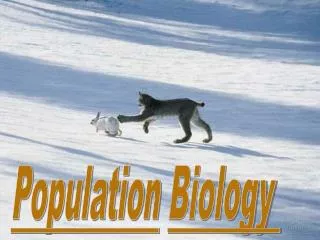
Limiting Factors C. Predation - feeding of one organism on another - density __________ Predators can improve prey population. How is that possible? Increased prey = increase predators and vice versa
Limiting Factors D. Parasitism - symbiosis between host and parasite - parasite usually doesn’t cause death - density __________ E. Disease - can spread faster in high densities - used by biologists to control pest populations (ex. Myxoma virus – rabbits) - density __________
Limiting Factors F. Interspecific Competition - competition between two different species - density ________ Competitive Exclusion Principle * Two populations CANNOT occupy the same ecological niche without one driving the other to extinction. (results in niche differentiation)
Limiting Factors G. Intraspecific Competition - competition between members of the same species - more intense than interspecific comp. - avoidance via: life cycles (tadpole/frog) seed dispersal (plants) social hierarchies (social animals) - density ____________
Limiting Factors H. Temperature - affects external environment - density ______________ Oxygen - more in aquatic systems - levels critical for survival (ex. Pollution increases bacterial growth, in turn decreases amount of dissolved oxygen) - density ______________