
Physical and Chemical Properties
E N D
Presentation Transcript
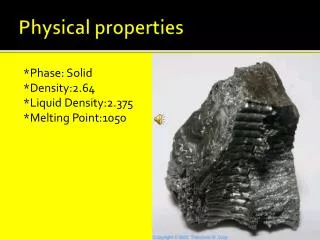
Physical Properties • Physical properties are characteristics that can be observed without changing the identity of the substance.
Physical Properties, continued • Physical properties can help identify substances. • Physical properties can be observed or measured. • Examples: shape, color, odor, texture, state, melting point, boiling point, strength, hardness, magnetism, the ability to conduct electricity or heat • melting point:the temperature and pressure at which a solid becomes a liquid • boiling point:the temperature and pressure at which a liquid becomes a gas • Physical properties help determine uses.
Physical Properties, continued • Density is a physical property. • density: the ratio of the mass of a substance to the volume of the substance • common unit of density is g/cm3 • Density is different from weight.
Chemical Properties • A chemical property describes how a substance changes into a new substance, either by combining with other elements or by breaking apart into new substances.
Chemical Properties, continued • Flammability is a chemical property. • flammability:the ability to burn • Reactivity is a chemical property. • reactivity:the capacity of a substance to combine chemically with another substance
Chemical Properties, continued • Physical and chemical properties are different. • Physical properties can be observed without changing the identity of a substance. • Chemical properties can be observed only in situations in which the identity of the substance changes.