Understanding Seasonal Candy Sales and Problem-Solving Strategies
This resource explores the hypothesis that candy sales fluctuate throughout the year based on seasonal trends. It emphasizes the importance of problem-solving strategies, such as retracing steps, the process of elimination, breaking down complex problems into simpler steps, making models, and identifying patterns. Real-life connections highlight the significance of assessing the nature of a problem to choose the appropriate problem-solving technique. Engaging activities, including solving puzzles and cryptograms, further illustrate the application of these strategies in practical scenarios.

Understanding Seasonal Candy Sales and Problem-Solving Strategies
E N D
Presentation Transcript
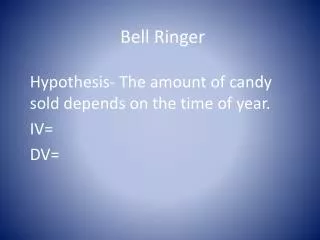
Bell Ringer Hypothesis- The amount of candy sold depends on the time of year. IV= DV=
Problem Solving Strategies • Retrace your steps • Process of elimination • Break down into simple steps • Make a model • Find a patern
Retrace Your Steps • Example- lost items • Where do you last remember having it, where did you go next
Process of Elimination • AKA- Trial/Error or Guess/Check • Examples fitting pieces into a picture puzzle
Break Down into Simple Steps • Examples- sports plays, math problems, memorizing speeches, memorizing play parts
Make a Model • Examples- blueprints
Find a Pattern • Examples- arithmetic sequences, cryptograms, code breaking
Real life connections • When you have a problem, you need to ask yourself what type of problem do I have. • You then can evaluate to possible problem solving technique to try. • If you actually use the technique you have turn the problem into an exercise. You are putting the technique to work. If you have still not solved the problem then you might have to try a different technique.
Using Problem Solving • Complete the Puzzler and Cryptogram