Understanding Chemical Equilibrium and Le Chatelier’s Principle
110 likes | 206 Vues
Explore the concept of chemical equilibrium, Le Chatelier’s Principle, and the effects of changing concentration and temperature on reactions. Learn to predict shifts in equilibrium based on different changes. Discover how pressure affects gases in a reaction.


Understanding Chemical Equilibrium and Le Chatelier’s Principle
E N D
Presentation Transcript
Chemical equilibrium Lab goes on p. 126-129 Start this on p. 130!!!!!!
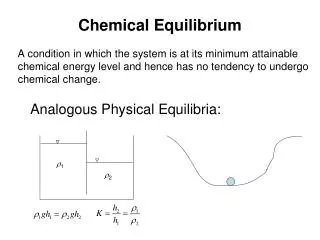
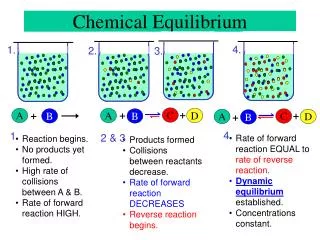
Forward and reverse reactions • Both the forward and reverse reactions have a reaction rate. • Chemical equilibrium is reached when the rates of the forward and reverse reactions are equal.
Le Chatelier’s Principle • We can disrupt a reaction’s equilibrium by changing parts of the reaction or the conditions of the reaction. (change temperature, add reactants, add products, etc.) • When we do this, the reaction has to make up for the difference, so it “shifts” the equilibrium to make up for the change.
Examples • For the following equations, predict the direction that the equilibrium will shift based on the change made to the reactants and products. • CH4 + 2O2 CO2 + H2O • Add CH4 – • Remove O2 – • Remove CO2 – • Add H2O –
Effect of changing temperature N2 + 3H2 2NH3 + 92 kJ • Exothermic reactions (heat is a product)
Endothermic reactions: heat is a reactant CaCO3 + 556 kJ CaO + CO2
Review • For the following equation, decide which direction the EQ will shift based on the change made. N2O4 + heat 2NO2 add N2O4 = add NO2 = decrease temp =
Change in Pressure • Changes in pressure only affect gases (g) • Remember from EL 7 that pressure and volume are inversely related, so they are opposites.
Examples P4(s) + 6Cl2(g) 4PCl3(l) add P4 = remove PCl3 = increase pressure = increase volume = add Cl2 =
4NH3(g) + 5 O2 (g) 4NO(g) + 6H2O (g) remove NH3 = increase volume = increase pressure = add O2 = add NO = remove H2O =