Radioactivity
Radioactivity is the process by which atomic nuclei emit radiation in the form of particles and rays. This guide covers the four types of radiation: alpha particles, beta particles, and gamma rays, including their compositions and penetration powers. Additionally, it explores radioactive decay, including half-lives and transmutation reactions, and details fission and fusion processes. We also discuss nuclear reactors and the challenges associated with spent fuel rods, crucial elements in harnessing nuclear energy safely.

Radioactivity
E N D
Presentation Transcript
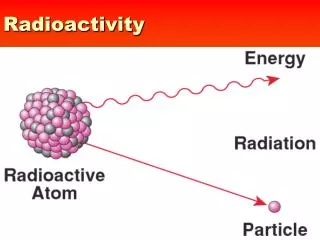
Radioactivity • The process by which nuclei emit particles and rays • These penetrating particles and rays are called radiation.
4 • Symbol is 2He or 2α 4 Types of Radiation • Alpha particle-two p+ and two n0 (helium nucleus) • Changes identity of the atom (drops by two atomic #’s) • Little penetrating power (stopped by paper or skin)
Types of Radiation • Beta particle- a high speed e- • Comes from a neutron that breaks apart • Changes identity of the atom (up one atomic #) • Stopped by Al foil or wood • Symbol is -1e or -1β
Types of Radiation • Gamma Radiation • High-energy photon emitted as a gamma ray • Often emitted along with α or β radiation • Does not change identity of the isotope • Highly penetrating and very dangerous to humans
Radioactive Decay as Equations • The symbols for the various particles are shown: • When a radioisotope changes identity, this is called a transmutation reaction.
Half-Life • Every radioisotope has its own rate of decay measured by its half-life. • Half-life (t½) is the time required for half the nuclei of that radioisotope to decay • Could be a fraction of a second or billions of years.
Fission • When nuclei of some isotopes are hit with neutrons, they split into smaller fragments. This is fission. • Every time an isotope splits, TREMENDOUS amounts of energy are released.
Fission Chain Reaction • In a chain reaction, the neutrons produced strike other atoms, which produce more neutrons, etc. • This is how a nuclear bomb works. • It is also how reactors work, but with controls.
Nuclear Reactors • Make use of the energy produced by fission.
Nuclear Reactors • The fuel rods from reactors, when spent, are a major waste issue. • They are stored indefinitely, or shipped to another location. • They won’t be safe until the isotopes are stable, which depends on the half-life of the isotope. • The next slide has some fuel rod photos.
Fusion • Occurs when nuclei combine to produce a heavier nucleus. • Occurs naturally in the sun. (4 H nuclei become 1 He nucleus) • It is how current nuclear warheads work.