Explore the impact of spatial and sensory language on learning, key brain regions, factors influencing learning, and tips to create engagement and improve input quality. Discover the importance of attention, engagement, and coherence in boosting learning outcomes.
01 / 70Enhancing Learning Through Brain-based Strategies
1 / 17
Télécharger la présentation
Enhancing Learning Through Brain-based Strategies
Une image / un lien ci-dessous est fourni (tel quel) pour télécharger la présentation
Politique de téléchargement : le contenu du site vous est fourni TEL QUEL pour votre information et votre usage personnel ; il ne peut être vendu, concédé sous licence ni partagé sur d’autres sites sans l’accord de son auteur.Le contenu vous est fourni TEL QUEL, pour votre information et votre usage personnel uniquement.Téléchargez la présentation en cliquant sur ce lien.Lors du téléchargement, si vous ne parvenez pas à télécharger une présentation, l’éditeur a peut-être supprimé le fichier de son serveur.Pendant le téléchargement, si vous ne parvenez pas à obtenir une présentation, le fichier a peut-être été supprimé par l’éditeur.
What’s my interest in Brain-Research? A- Ken…tell me more on the edge of my seat. B- Sounds Kewl man…I’m interested C- This might be okay! D- Please…My plates too full. E- No thanks…It’s just another fad
Spatial and Sensory Language,writing, hearing Visual processing ParentVoice Motor memory Thalamus- first stop for sensory information Hypothalamus- monitors internal systems Amygdala- Emotions are processed here Hippocampus- consolidates memories/learning
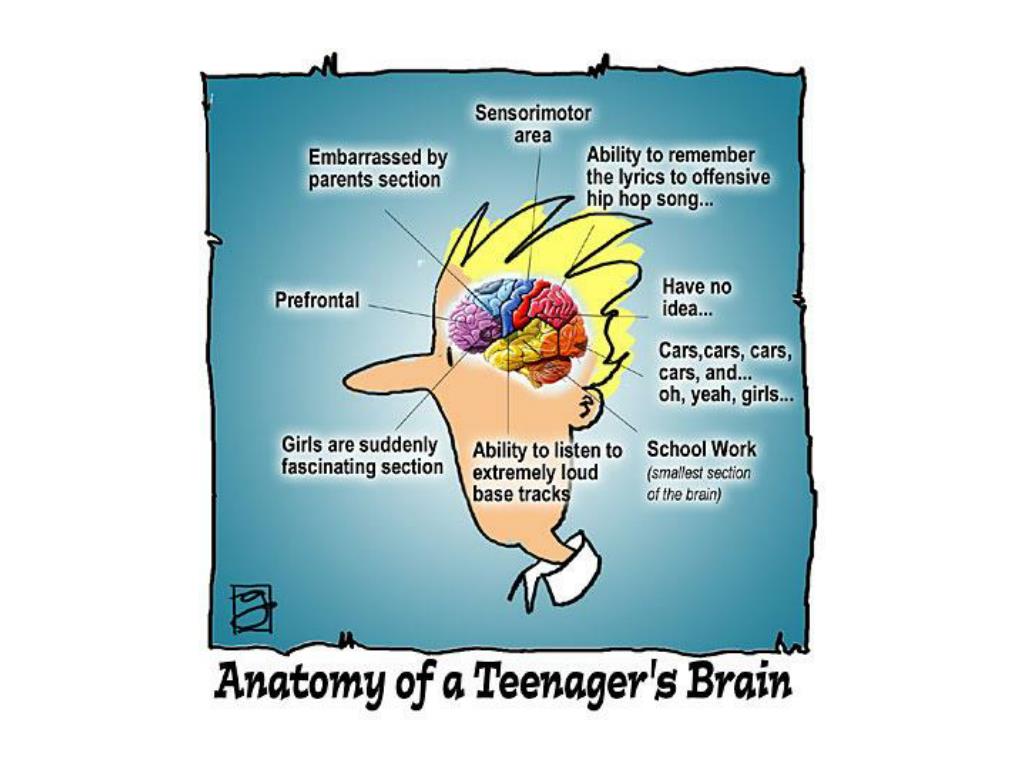
Frontal Cortex and Limbic System The frontal cortex is in charge of creativity, planning, strategizing, decision making and judgment. The limbic system is primarily responsible for our emotional life, and has a lot to do with the formation of memories. Teens use the limbic system more than adults for processing responses. Adults rely more on the frontal cortex, which governs reason and planning.
Engagement: It’s harder than we “think” • Biological relevant stimuli is stronger than curriculum. • Survival instincts: Hunger, safety, breeding • Paying Attention requires that we orient, engage, and maintain independent neural networks. • When stimuli are working, pleasure centers are activated
Engagement: When does it happen? • When students choose relevant, meaningful learning. • When you “capture” learners (limited) attention. • When interacting with others in small groups. • When glucose levels are at proper levels • When threat is minimized
Engagement:How do we create it? • Provide opportunity for student choice/voice • Brevity: Cut the length of focused attention time. The human brain is poor at nonstop attention. • Increase interaction among peers. • Goal Setting • Activated Amines : (the brains uppers) Change activity and focus regularly
This info was new to me? A- Wow…What a surprise! B- I had heard this, its good to have confirmed C- I knew this, but it was a good reminder
Input Quality: • It more useful to view the human species as bad at thinking rather than cognitively gifted. • Respect short term memory (the Hippocampus is a surge protector) • Exploit the visual function of the brain
Input Quality: • In-depth learning requires time for organizing, integrating and sorting new information. • We have an enormous lifetime capacity for learning…but on a daily (per task) basis we are very limited. • Our brains need processing time
Input Quality…quantity • Synaptic gap: building new connections for explicit learning happens with in 15 minutes of exposure to new information and continue to strengthen during the next hour.
Input : Neurons • If the synapse is disturbed before it can be set the memory is lost. • The brain must recycle proteins in the neurons during an incubation or settling time. • Downtime is essential for the hippocampus to do it’s work of consolidation. • Sleep is also essential
Input: Suggestions • Activities must make meaning and sense • Respect the limits of short term memory • Brains need rest breaks (settling time). No new learning can happen during settling time. (only practice or discussion) • The amount of settling time depends on the content and learner. 2-5 minutes of processing for every 10-15 minutes of instruction.
Coherence: Relevance • Content will get attention if it is: Emotional, Specific or Novel (not familiar). The brain is good at habituation. • Content is more likely to become meaningful to us if we can: • Relate it to familiar, prior information. • Be both active and reflective with it. • Learn it in context
Coherence: Prior knowledge • Prior knowledge is physical brain matter • Prior knowledge fundamentally influences how students gain deep understanding. (word association) • Prior knowledge is personal, complex and highly resistant to change. • The best way to teach is to build on it.
Building Memory Working Memory ? Environment Long-Term Memory ?
The Towers of Hanoi Problem: Move the wooden circles from one peg to another without placing a larger circle on a smaller circle.
In the inns of certain Himalayan villages is practiced a refined tea ceremony. The ceremony involves a host and exactly two guests, neither more nor less. When his guests have arrived and seated themselves at his table, the host performs three services for them. These services are listed in the order of the nobility the Himalayans attribute to them: stoking the fire, fanning the flames, and pouring the tea. During the ceremony, any of those present may ask another, “Honored Sir, may I perform this onerous task for you?” However, a person may request of another only the least noble of the tasks that the other is performing. Furthermore, if a person is performing any tasks, then he may not request a task that is nobler than the least noble task he is already performing. Custom requires that by the time the tea ceremony is over, all the tasks will have been transferred from the host to the most senior of the guests. How can this be accomplished?
Simply put…thinking requires: • Information from the environment • Facts in long-term memory • Procedures in long-term memory • “Space” in short-term memory. (7)
Keys to creating memories… • Emotion • Attention • Repetition • Thinking about meaning • How you do this will determine what you remember. (auditory, visual, etc.)
Power of Stories Human mind is exquisitely tuned to understand and remember stories • Causality • Conflict • Complication • Character • Comprehending requires inferences…forcing you to think about meaning. • Stories have causal structure…one thing leads to another
The body clock: Ultradian Patterns • Our body clock seems to run in 90-110 minute cycles of low to high energy or relaxation to tension. • Generally speaking learners will focus better in the late morning and early evening. • Physical exercise can trick the body clock.
Repetition • “Attentive” repetition strengthens (synapse) connections in the brain. • Pre-exposure: prepares to brain for future learning through creating background knowledge. • Pre-viewing: activates prior knowledge.
Emotions affect all aspects of learning, retention, and recall. (novelty seeker) • Past experiences always affect new learning. (knowing your students is essential) • The brain’s working memory has limited capacity. (hippocampus) • Teacher centered instruction usually results in the lowest degree of retention.
This info was new to me? A- Wow…What a surprise! B- I had heard this, it’s good to have confirmed C- I knew this, but it was a good reminder
Connexion au compte
Connectez-vous pour publier votre contenu sur SlideServe.