Enhancements in Electronics Design for TPC Readout: Signals, Rates, and Real Estate Considerations
This document examines the expected signal performance and electronic design improvements for Time Projection Chambers (TPC) focusing on Micromegas and GEM technologies. It highlights anticipated signal amplitudes based on gas choice and pad geometry, aiming to optimize gain and minimize ion feedback. Despite noise constraints, the design must ensure high dynamic range and efficient power consumption. The analysis also considers the influence of background occupancy on data rates and introduces recommendations for refining electronics, with an emphasis on versatility across various applications.

Enhancements in Electronics Design for TPC Readout: Signals, Rates, and Real Estate Considerations
E N D
Presentation Transcript
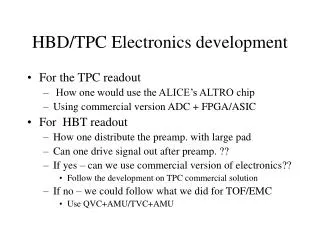
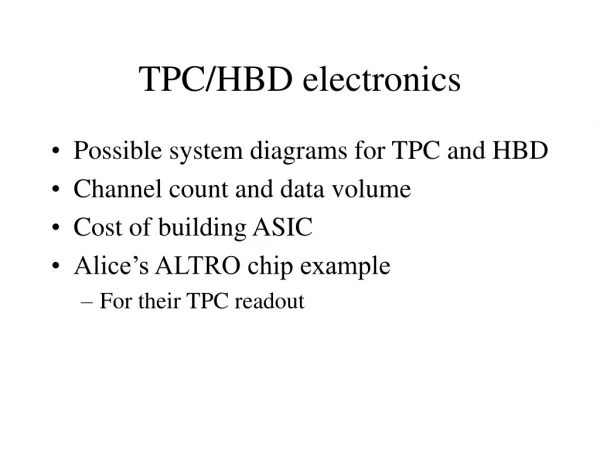
Electronics for LC TPC Expectedsignals, rates, real estate
Expectedsignals Mesh signal • Micromegas (as seen by a fast amplifier): • GEMs: onlyelectron signal, but enlarged by longitudinal diffusion over the transfer gaps O(ns) • In both cases, superposition of 50-70 electronssmeared by longitudinal diffusion (O(100 ns)) and track angle. • No significantdifferenceoverall as drift effectsdominate Pad signal
Expected signal amplitude • Given the pad length and the gaschoice (probably Ar-based), weexpect 50-70 ionizationelectrons per padrow. • There willbe an attempt to limit the gain to about 1000, to avoidfeeding back toomany ions • There are long tails in the ionization distribution (say 5 times the mean value) • Overall, we have to be sensitive from 0.2 fC to 60 at least, thus have noise < 500 e- rms and at least 11 bit dynamics.
From A. Kluge, TWEPP09 • Triggerlessreadout of 1 ms basic units
Data rate and occupancy • Dominated by background (integrate up to 80 bunchcrossings in one TPC volume) : 1000 photon, 140 neutrons, (300 e- produced) per bunchcrossing. • r-dependent (diminishesfromlow r to high r)
Power consumption Real estate • Present main streams are 2-3 mm x 7 mm pads for Micromegas and 1 mm x 4-5 mm for GEMs. Small pads mightberequiredalso for Micromegas atsmallr because of occupancy by background. • Presentnumbersfrom ALTRO and AFTER based test electronics: • ALTRO 40-80 mW/ch, AFTER 20 mW/ch • For ‘main stream’ pad size thisis 10-20 kW/m² for GEMs and 1 kW for Micromegas.
Summary • Time (2013) to re-thinkfrom scratch theelectronics for ILD TPC readout • Shouldalsobe usable for otherprojects • 130 nm seems to be the technology, but mightbequestionned • Power distribution and consumption are important issues (taking in and out power bothneedmatter) • To startwith: improve SALTRO 16 design: • Compact, makeless gourmand ADC, maybegetread of digital filter • Work out storage and real-time data reduction