Download
1 / 7
70 likes | 212 Vues
This chapter explores the situational influences that affect helping behaviors, highlighting the Bystander Effect first identified in the 1964 murder of Kitty Genovese. It discusses how bystanders react in emergencies and introduces Darley and Latane’s experiments on group dynamics when witnessing a crisis. Key concepts like the diffusion of responsibility, pluralistic ignorance, and obstacles to intervention are examined. Additionally, the chapter considers cultural, urban/rural differences in helping behaviors, and factors such as gender and attractiveness that influence whom is helped.

E N D
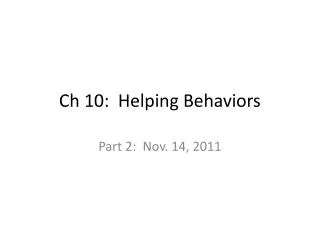
Ch 10: Helping Behaviors Part 2: Nov. 14, 2011
Situational Influences on Helping • Effect of crowds: The Bystander Effect • Research on this began w/Kitty Genovese murder in 1964 in NYC • Details of the incident? • How did bystanders react?
Darley & Latane’s follow-up experiments: Confederate appear to have seizure …either alone, with 1 other participant, or 4 other participants What is ‘Diffusion of Responsibility’?
Obstacles to helping in these situations? • Noticing • Interpreting • Shotland’s research on intervening in male-female assaults • The role of pluralistic ignorance • Responsibility • Deciding how to help
Other situational influences on helping: • Rural/Urban areas: • Culture: • Role modeling:
Who gets helped? • The roles of attractiveness & responsibility: • Gender: • Based on type of situation
Increasing Helping • Note that people do not always want help • Increasing helping among bystanders - • Avoid the overjustification effect – • Issue among volunteer orgs: