

SlideServe
Menu
Préférences
© SlideServe · v2026

Sensory Systems

oralee avatar
45 diapositives · 749 Views · Aug 08, 2014

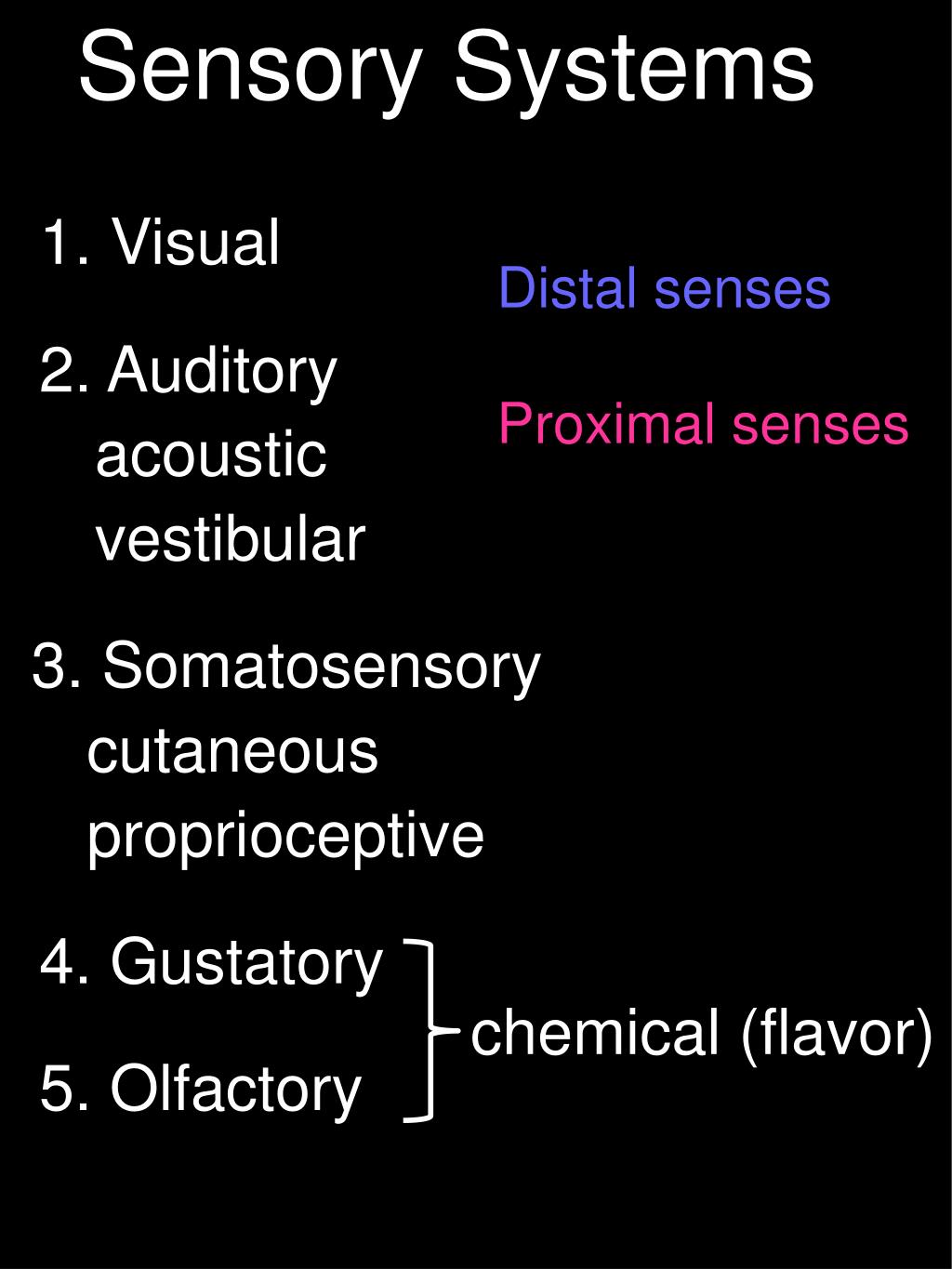
Sensory Systems. 1. Visual. Distal senses. 2. Auditory. Proximal senses. acoustic. vestibular. 3. Somatosensory. cutaneous. proprioceptive. 4. Gustatory. chemical (flavor). 5. Olfactory. Somatosensory Systems. cutaneous proprioceptive. Adequate Stimulus
Sensory Systems - slide 1
01 / 45Sensory Systems
1 / 17

Télécharger la présentation

Sensory Systems
Une image / un lien ci-dessous est fourni (tel quel) pour télécharger la présentation

Politique de téléchargement : le contenu du site vous est fourni TEL QUEL pour votre information et votre usage personnel ; il ne peut être vendu, concédé sous licence ni partagé sur d’autres sites sans l’accord de son auteur.Le contenu vous est fourni TEL QUEL, pour votre information et votre usage personnel uniquement. Téléchargez la présentation en cliquant sur ce lien. Lors du téléchargement, si vous ne parvenez pas à télécharger une présentation, l’éditeur a peut-être supprimé le fichier de son serveur.Pendant le téléchargement, si vous ne parvenez pas à obtenir une présentation, le fichier a peut-être été supprimé par l’éditeur.

F I N

Plus de contenu associé

Transcription de la présentation
  1. Sensory Systems 1. Visual Distal senses 2. Auditory Proximal senses acoustic vestibular 3. Somatosensory cutaneous proprioceptive 4. Gustatory chemical (flavor) 5. Olfactory

  2. Somatosensory Systems cutaneous proprioceptive

  3. Adequate Stimulus A stimulus of a quality and of sufficient intensity to excite a sensory receptor.

  4. Adequate Stimuli for Somatosensation Thermal (infrared radiation, contact) Touch (light touch, pressure, vibration) Pain and Itch (chemical, thermal, mechanical) Proprioception (mechanical; stretch or pressure)

  5. Cutaneous subsystems epicritic location vibration texture shape protopathic pain temperature itch and tickle

  6. Receptive field That part of the periphery to which a cell responds.

  7. Meissner’s Merkel’s 60 hz vibration Pressure Pacinian Ruffini’s Free nerve ending Pain Stretch 200 hz vibration

  8. Summation of responses of different receptors (spatial summation).

  9. Coding of intensity by increased rate (temporal summation).

  10. Epricritic, or non-pain Somatosensation

  11. As in the retina, receptive fields vary in size. Smaller receptive fields = greater acuity two-point discrimination

  12. Center-surround organization of cutaneous receptive fields results in lateral inhibition. Serves to enhance contrast

  13. Protopathic, or pain Somatosensation

  14. Pain Receptors Called Nociceptors • Free nerve endings that respond to: • mechanical stimuli • thermal stimuli • chemical stimuli, or • all three • (polymodal receptors)

  15. Free nerve endings of unmyelinated C fibers or thinly myelinated Aδ fibers

  16. Cutaneous classified by conduction velocity Proprioceptive classified by axon diameter

  17. SubstanceEffect Potassium activation Bradykinin activation Histamine activation Prostaglandins sensitization Substance P sensitization

  18. Gate control theory of pain control Transcutaneous electrical nerve stimulation may act via gate control

  19. Referred Pain

  20. CN V and VII

  21. Parallel Processing in the Somatosensory System Lemniscal System (non-pain; epicritic) Extralemniscal System (pain; protopathic) Spinothalamic pathways Neospinothalamic Paleospinothalamic Spinomesencephalic

  22. Neospinothalamic Paleospinothalamic Spinomesencephalic

  23. Neospinothalamic Pathway

  24. Paleospinothalamic Pathway

  25. Spinomesencephalic Pathway

  26. Descending control of pain

  27. Sensory System Summary 1. Sensory systems detect change over space (lateral inhibition to enhance contrast) over time (rapidly adapting) 2. Detect “features” 3. Structures are laminated (cells in layers) 4. Parallel pathways 5. Hierarchical processing 6. Topographical organization 7. Non-uniform receptive fields 8. Extreme sensitivity, wide dynamic range 9. Non-linear response