Exploring Neutrino Physics with IceCube Simulation: Unmatched Sensitivity to New Physics Signatures
230 likes | 327 Vues
Dive into the world of neutrino physics using the IceCube simulation with over 10 years of total statistics. Discover the phenomena of neutrino oscillations, interactions, regeneration, and decay, unveiling new physics signatures with unprecedented sensitivity. Experiment with atmospheric neutrinos and cosmic neutrino beams, aiming to detect new vector/tensor-like interactions and potential violations of fundamental principles. Explore the cosmic neutrino beam from pion decay and unravel the mysteries of neutrino masses and decay processes in varying mass eigenstates. Join the quest to understand high-energy phenomena like blazar emissions and black hole radiation enveloping, with cutting-edge observations and simulations. The future of neutrino beams holds a promise of unraveling cosmic ray origins and energy conservation puzzles. Don't miss out on the thrilling exploration of neutrino physics with IceCube simulation!


Exploring Neutrino Physics with IceCube Simulation: Unmatched Sensitivity to New Physics Signatures
E N D
Presentation Transcript
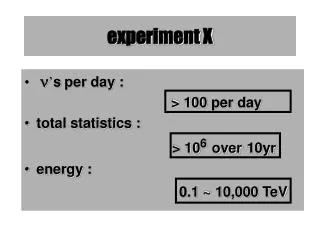
experiment X • n’sper day : > 100 per day • total statistics : > 106over10yr • energy : 0.1 ~ 10,000 TeV
IceCube… 1 million neutrinos analytic IceCube simulation TeV neutrinos oscillate, propagate, regenerate and decay… coherently new physics signatures unmatched sensitivity Gonzalez-Garcia, Maltoni
your own IceCube simulation • # events = ∫ Area Timefn{lm/ln } • Input: A (Em) from astro-ph/0305196 Cuts: • length of muon track > 300 m • number of channels as a function of zenith angle q • implemented as integration limits on the muon • range and energy as a function of zenith
Neutrinos • oscillate • interact • regenerate • tau decay
New Physics with the Atmospheric Beam with induced by new vector/tensor-like interactions
New Physics with the Atmospheric Beam: Examples • Violation of the equivalence principle: • Violation of Lorentz invariance:
Total 455,246 (10 years)
Cosmic neutrino beam from the decay of pions e : : ~ 1 : 2 : <10-5@ the source e : : ~ 1 : 1 : 1 @ the detector (maximal mixing) • Or, • zero mass eigenstates in vacuum • neutrino decay • neutrinos of varying mass • …..
TeV B L A Z A R 1ES 1959+650 a posteriori coincidence TeV Flux (Crab) H. Krawczynski et al, 2004ApJ,601 151K ‘Multiwavelength Observations of Strong Flares from the TeV Blazar 1ES 1959+650’ 10 keV Flux (keV-1 cm-2 s-1) “orphan” flare PRELIMINARY
Neutrino Beams: Heaven & Earth NEUTRINO BEAMS: HEAVEN & EARTH Black Hole Radiation Enveloping Black Hole p + g -> n + p+ ~ cosmic ray + neutrino -> p + p0 ~ cosmic ray + gamma
g-rays fromp0decay discovered ? 1 < < 8 accelerator beam dump (hidden source) transparent source p0 = p+ = p- ∫ En Nn (En) = ∫EgNg (Eg) n flux predictedobserved g-ray flux ~20 per km2 RX J1713-3946 per year (galactic center)
HESS: RX J1713 Spectrum 18 h 2003 data Resolution ~10 arcmin First resolved TeV image
energy conservation and cascading E-2.8 E-2 TeV G m p0
Input: transparent source of 1 Crab with 2 < Eg < 20 TeV gamma ray slope 2.8 2.5 2.2 1E 1959+680