Understanding the Normal Menstrual Cycle: Phases, Duration, and Hormonal Influence
The normal menstrual cycle (MC) averages 28 days, with variations between 21 to 35 days. It consists of four main phases: Follicular, Ovulation, Luteal, and Menstruation, regulated by the interaction of the hypothalamus, pituitary gland, and ovaries. The mean duration of menstruation is 3 to 8 days, with estimated blood loss of about 30 ml. Key hormonal changes, particularly in FSH, LH, estrogen, and progesterone, govern ovulation typically occurring around day 14. Understanding these processes is essential for reproductive health.

Understanding the Normal Menstrual Cycle: Phases, Duration, and Hormonal Influence
E N D
Presentation Transcript
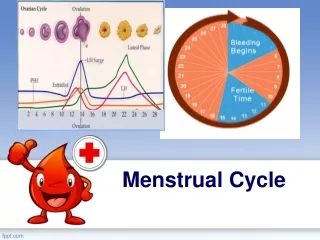
NORMAL MENSTRUAL CYCLE mean duration of the MC Mean 28 days (only 15% of ♀) Range 21-35 average duration of menses 3-8 days normal estimated blood loss Approximately 30 ml ovulation occur Usually day 14 36 hrs after the onset of mid-cycle LH surge
NORMAL MENSTRUAL CYCLE the phases of the MC & ovulation regulates by: Interaction between hypothalamus, pituitary & ovaries mean age of menarche & menopause are: Menarche 12.7 Menopause 51.4
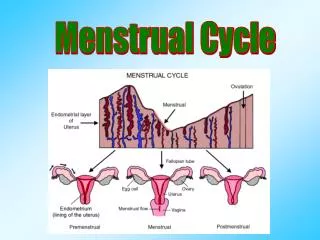
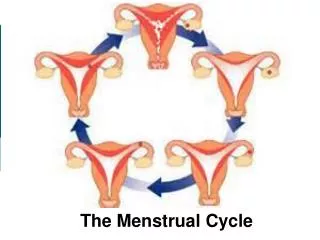
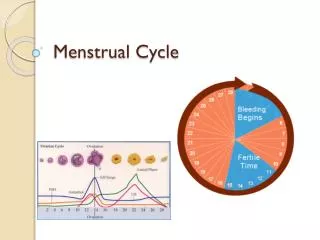
The Cycle • Strongly linked to the endocrine system (hormone based and paracrine based) • Typically takes 28 days to cycle through 4 phases • Follicular • Ovulation • Luteal • Menstruation • Hormones raise and fall
Follicular • Begins when estrogen levels are low • Anterior pituitary secretes FSH and LH, stimulation follicle to develop • Cells around egg enlarge, releasing estrogen • This causes this uterine lining to thicken
Ovulation • LH and FSH still being released, for another 3-4 days • Follicle ruptures, releasing ova into the Fallopian tubes
Luteal • Now empty follicle changes to a yellow colour, becomes corpus luteum • Continues to secrete estrogen, but now beings to release progesterone • Progesterone further develops uterine lining • If pregnant, embryo will release hormones to preserve corpus luteum
Menstruation • Menstruation • If no embryo, the corpus luteum begins to disintegrate • Progesterone levels drop, uterine lining detaches, menstruation can begin • Tissue, blood, unfertilized egg all discharged • Can take from 3-7 days
PHYSIOLOGYOF THE MENSTRUAL CYCLE Ovulation divides the MC into two phases: 1-FOLLICULAR PHASE -Begins with menses on day 1 of the menstrual cycle & ends with ovulation
FOLLICULAR PHASE MATURATION OF THE FOLLICLE (FOLLICULOGENESIS) ♥ FSH primordial follicle Primary follicle Secondary follicle tertiary or antral follicle
OVULATION • The dominant follicle protrudes from the ovarian cortex • Gentle release of the oocyte • Mechanism of follicular rupture 1- Follicular pressure 2-Enzymatic rupture of the follicular wall
ENDOMETRIAL CHANGES DURING THE MENSTRUAL CYCLE 1-Basal layer of the endometrium -Adjacent to the myometrium -Unresponsive to hormonal stimulation -Remains intact throughout the menstrual cycle 2-Functional layer of the endometrium
MENSTRUATION • Periodic desquamation of the endometrium • Just before menses the endometrium is infiltrated with leucocytes • Prostaglandins are maximal in the endometrium just before menses • Prostaglandins constriction of the spiral arterioles ischemia & desquamation Followed by arteriolar relaxation, bleeding & tissue breakdown
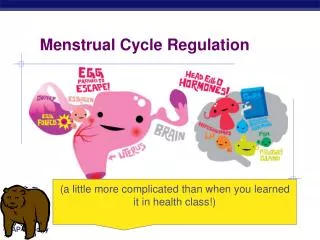
HYPOTHALAMIC ROLE IN THE MENSTRUAL CYCLE • The hypothalamus secretes GnRH • GnRH activity is first evident at puberty • Release of GnRH is modulated by –ve feedback by: steroids gonadotropins