Understanding the February 1917 Russian Revolution: Causes and Key Events
Explore the pivotal events leading to the February 1917 Russian Revolution and Tsar Nicholas II's abdication. This lesson uses a visual ladder approach to document key incidents, helping students analyze significant causes, such as the impact of World War I and domestic unrest. Discover the role of key figures, including the Tsarina and Rasputin, and the factors contributing to the loss of support for the Tsar. Engage with the topic by ranking causes and differentiating between long-term and short-term influences on the revolution.

Understanding the February 1917 Russian Revolution: Causes and Key Events
E N D
Presentation Transcript
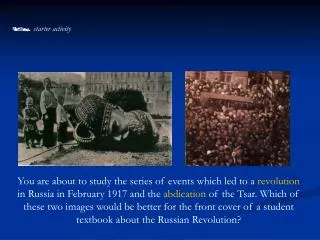
starter activity You are about to study the series of events which led to a revolution in Russia in February 1917 and the abdication of the Tsar. Which of these two images would be better for the front cover of a student textbook about the Russian Revolution?
Lesson overview • Draw a ladder with 7 large steps. Below each step you are going to note down the key events that led to the February 1917. • Decide which was the most significant cause of the Revolution from a list of factors
Step 1 – the effects of war • Russian defeats at Tannenberg & Masurian Lakes • 1 million+ casualties or POWs by end of 1914 • Terrible conditions
Step 2 – effects of war at home • Food & fuel shortages • Inflation • Unemployment • Soldiers returning from frontline • Ban on sale of vodka! Bread queue, Moscow, 1917
Step 3 – Tsar Nicholas goes to the front, September 1917 • Tsar was seen as personally responsible • Tsarina (German) running country with Rasputin Rasputin Tsarina
Step 4 – loss of support • Middle classes wanted greater say in govt. • Upper classes resented Tsarina & Rasputin • Harsh winter of 1916 Middle-class Muscovites
Step 5 – revolution begins • 7 March, 40,000 workers from Putliov engineering works in Petrograd go on strike • 8 March, International Women’s Day • Tsar orders use of force A demonstration on International Women’s Day, 8 March 1917
Step 6 – army takes sides • 12 March, army refuses to obey orders • Some regiments shot officers • Joined demonstrators and marched on Duma
Step 7 – Tsar abdicates • Railway workers refused entrance to Petrograd to Tsar • Tsar abdicates • Exiled to Siberia
Your task • Copy the following causes of the February 1917 Revolution. Rank them in order of importance and then try to group them in terms of long- and short-term causes and trigger events.