SlideServe
Menu
Préférences
© SlideServe · v2026

The Impact and Nutritional Value of Fast Food in Modern Culture

pberryman avatar
6 diapositives · 614 Views · Jan 02, 2020

Fast food, representing a massive industry, refers to meals prepared in bulk and served quickly, primarily by franchise establishments. While convenient, fast food often contains additives and hydrogenated oils that diminish nutritional value and may lead to health issues. The surge in fast food consumption is notable, with U.S. spending increasing from $6 billion in 1970 to $110 billion in 2000. Cultural narratives around fast food include the novel "Fast Food Nation" and the documentary "Super Size Me," which critique the industry's influence on societal health and habits.
The Impact and Nutritional Value of Fast Food in Modern Culture - slide 1
01 / 6The Impact and Nutritional Value of Fast Food in Modern Culture
1 / 17

Télécharger la présentation

The Impact and Nutritional Value of Fast Food in Modern Culture
Une image / un lien ci-dessous est fourni (tel quel) pour télécharger la présentation

Politique de téléchargement : le contenu du site vous est fourni TEL QUEL pour votre information et votre usage personnel ; il ne peut être vendu, concédé sous licence ni partagé sur d’autres sites sans l’accord de son auteur.Le contenu vous est fourni TEL QUEL, pour votre information et votre usage personnel uniquement. Téléchargez la présentation en cliquant sur ce lien. Lors du téléchargement, si vous ne parvenez pas à télécharger une présentation, l’éditeur a peut-être supprimé le fichier de son serveur.Pendant le téléchargement, si vous ne parvenez pas à obtenir une présentation, le fichier a peut-être été supprimé par l’éditeur.

F I N

Plus de contenu associé

Transcription de la présentation
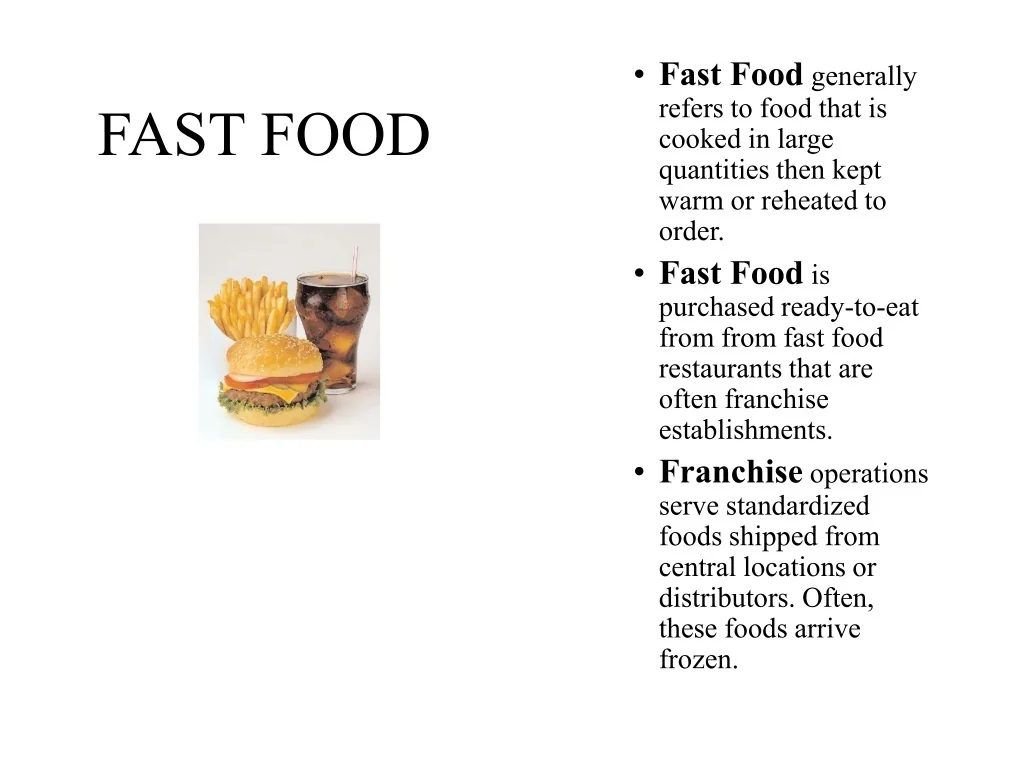
  1. FAST FOOD • Fast Food generally refers to food that is cooked in large quantities then kept warm or reheated to order. • Fast Food is purchased ready-to-eat from from fast food restaurants that are often franchise establishments. • Franchise operations serve standardized foods shipped from central locations or distributors. Often, these foods arrive frozen.

  2. Fast Food Nutritional Value Fast Foodmeals generally consists of ingredients formulated for a certain flavor and to maintain freshness. Fast Food products are often full of hydrogenated vegetable oils that contain high amounts of trans fat. Fast Food ingredients undergo extensive processing and contain many additives that reduce the nutritional value.

  3. FAST FOOD = BIG BUSINESS Fast Food restaurant chains have increasing sales each year. In 1970 in the United States, consumers spent $6 billion on fast food meals. In 2000, American consumers spent $110 billion on fast food meals. Fast Food Nation is a novel that investigates the local and global influence of the United States fast food industry.

  4. FAST FOOD in the MOVIES Fast Food Nation, the novel, was adapted into a major motion picture. However, it was not received with nearly as much acclaim as the original novel. Super Size Me is a film that was directed by and starring Morgan Spurlock. The film covers a 30-day period in which Spurlock ate only at McDonald’s, which is arguably the largest, most globally-renowned American fast food company.

  5. ENERGY DRINKS Energy Drinks are quite popular in the United States. They seem to hold great appeal to people for the fast-paced life-styles that many individuals maintain. Energy Drinks are essentially soft drinks designed to provide energy. The central ingredient in both soft drinks and energy drinks is caffeine. Other common ingredients include B vitamin, extracts from the guarana plant, and other herbal ingredients. Some contain high levels of sugar. Others are artificially sweetened.

  6. VITAMINS Vitamin supplements can be purchased in almost any grocery stores, drug stores, or even convenience markets. Vitamins are considered dietary supplements. They are not meant to substitute regular, well-balanced meals. They can add into a person’s diet essential nutrients that may otherwise be lacking. Vitamins encapsulated in pill form are packaged in bottles of 50, 100, or up to 1000 pills with clear labels listing the contents