Understanding Electric Fields: Charge Distributions and Rod Analysis in Chapter 16
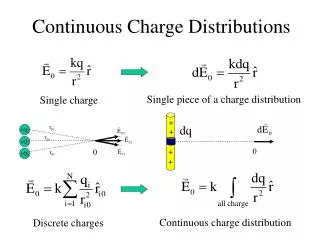
This activity delves into the complexities of electric fields generated by continuous charge distributions, specifically examining the mathematical framework surrounding a charged rod. It covers key concepts such as total charge (Q), length (L), and the transition from differential elements (dy to Dy) in calculating electric fields. Additionally, the implications of varying lengths compared to charge configurations are explored, including scenarios of infinite and tiny charge distributions, relating back to Coulomb's Law for a comprehensive understanding of the topic.

Understanding Electric Fields: Charge Distributions and Rod Analysis in Chapter 16
E N D
Presentation Transcript
W4D1 Continuous Charge Distributions Chapter 16 Electric Field of Distributed Charges The Math for the rod (from class) www.iclicker.com
Activity – The Hard Part! BREAKING UP THE ROD
Let’s review the math a little y=L/2 Total charge = Q Total Length=L m=Q/L switch from dy to Dy dy y O dq=mdy x-axis
Doing the math From tables of integrals …
What happens when L gets really big compared to L? (Infinite line of charge)
What happens when L is very SMALL compared to r?? (Teeny Tiny.) coulomb’s Law!!