Exploring Mercury: The Mysterious Innermost Planet of Our Solar System
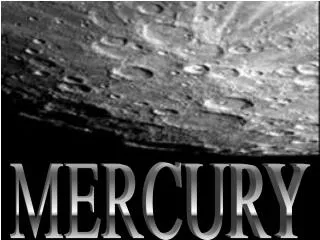
Mercury, the second smallest planet in our solar system, is often referred to as the "morning star" due to its bright appearance before sunrise. Its surface is heavily cratered, resembling that of the moon, and it has been significantly impacted by meteor collisions. Mercury has a unique lopsided magnetic field, extreme temperatures ranging from 200 to 700 Kelvin, and no moons or rings. It rotates slowly, taking 59 Earth days for a single rotation, while its orbit around the sun is completed in just 88 Earth days. Life as we know it is unlikely to exist in its harsh conditions.

Exploring Mercury: The Mysterious Innermost Planet of Our Solar System
E N D
Presentation Transcript
Mercury Elisabeth & Cody & Amber
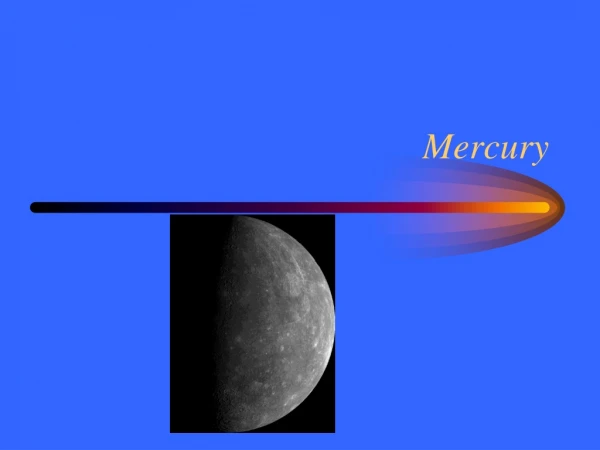
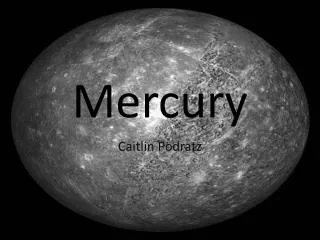
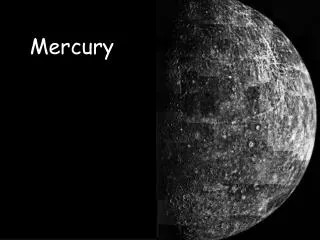
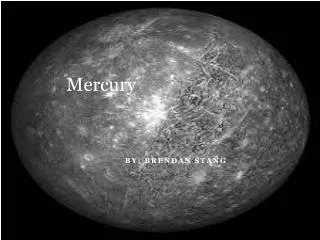
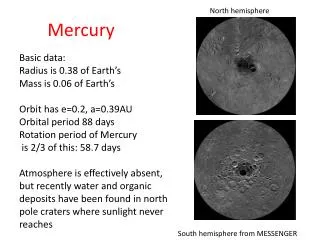
Mercury’s Features- • Most similar to the moon. • The surface of Mercury has been pounded by meteor impacts. • Has a lopsided magnetic field. • No moons. • 2nd smallest planet
Mercury……. • Was named after a roman god, god of commerce • Absorbs most of the sunlight that strikes • A night on mercury is about 3 months One rotation=59 days • Mercury has greatest temperatures extreme, highest=700 kelvin lowest=200 kelvin • The odds of life as we know it existing on mercury are almost non existent.
Mercury….. • The planet mercury is often called a morning star because it shines brightley in the early morning before the sun rises. • Mercury moves around the sun faster than any other planet. • Mercury is also really dry, and extremely hot and almost airless. • It travels around the sun faster than any other planet. • Has a thin mixture of helium (95%) and hydrogen.
Mercury…… • The rotation on earths axis is 59 earth days • Rotation around the sun is 88 earth days. • There are 0 satellites and 0 rings.