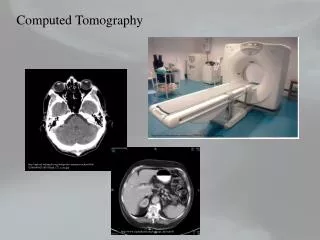
Computed Tomography
Computed Tomography. Diego Dreossi Silvia Pani University of Trieste and INFN, Trieste section. Summary. Computed Tomography Purpose How does it work? CT reconstruction Filtered backprojection Synchrotron radiation CT MicroCT at the SYRMEP beamline Further applications. The goal.

Computed Tomography
E N D
Presentation Transcript
Computed Tomography Diego Dreossi Silvia Pani University of Trieste and INFN, Trieste section
Summary • Computed Tomography • Purpose • How does it work? • CT reconstruction • Filtered backprojection • Synchrotron radiation CT • MicroCT at the SYRMEP beamline • Further applications
The goal • To provide a three-dimensional information (depth of the structures/organs) • To provide information about the attenuation coefficient (tissue characterization)
From planar imaging… to CT Source: University of Arkansas Medical School http://anatomy.uams.edu/HTMLpages/anatomyhtml/xraythorax.html
How does it work? • Laminar beam and laminar detector • The object/patient is rotated in front of the beam • During the rotation, planar images (projections) are acquired at different angles • The matrix of acquired data is called SINOGRAM: each line of the sinogram corresponds to a projection at a given angle • A map of the attenuation coefficients is reconstructed from the sinogram by means of proper algorithms
Image acquisition • The line integral of the attenuation coefficient determines the attenuation along each X-ray path
y v P(t) t F[P(t)] u x F(u,v) f(x,y) X-rays Image reconstruction: backprojection • Purpose: obtaining the distribution function f(x,y) given a complete set of projections P(q,t) • Fourier slice theorem: the FT of a projection P(q,t) corresponds to a sampling of the FT of f(x,y) along a line tilted by an angle q
v u Filtered backprojection • Each pixel of the matrix is reconstructed by summing up all projections crossing it • But: oversampling for low frequencies! Filtering: each transformed projection is multiplied by a function reducing the contribution of low frequencies
Filtered backprojection • Ramp filter (RamLak): enhancement of high frequencies noise • Gen-Hamming, Shepp-Logan: enhancement of intermediate frequencies • Convolution theorem convolution in the direct space as an alternative to multiplication in the Fourier space
q+180° q q q+180° The advantages of SR CT – I • Parallel beam: • an acquisition across 180 degrees provides all necessary information (lower dose – shorter acquisition time) • simplified reconstruction algorithms divergent beam parallel beam
The advantages of SR CT – II • Monochromatic beam: • No beam hardening artifacts • Possibility of reconstructing true attenuation coefficients tissue characterization
MicroCT at the SYRMEP beamline - I sample BEAM CCD detector rotational stage
90 degrees 140 degrees 0 degrees MicroCT at the SYRMEP beamline - II • A projection = a 2048 * 300 matrix • A height h is chosen • A line at height h is extracted from each projection and a sinogram is formed
MicroCT at the SYRMEP beamline - III • The sinogram is trimmed in order to have the center of rotation coincident to the center of the matrix
= -ln ( )/I0 MicroCT at the SYRMEP beamline - IV • The sinogram is transformed in order to obtain line integrals of the attenuation coefficients
MicroCT reconstructions at the SYRMEP beamline - V • Each line of the logarithmic sinogram is filtered • The final image is obtained by means of a backprojection Volume rendering
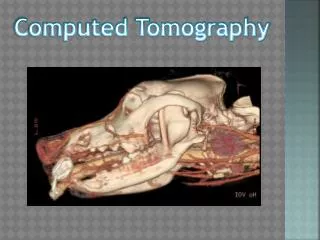
Volume rendering • 2-d images are stacked • The 3-d structure of the object is visualized
A possible application: sintered replicas of biological samples • Why? • Tool for enhanced visualization • Used in mechanical tests to assess the bone architecture load bearing capabilities • Tests on biological samples cannot be repeated! • How? • Built by rapid prototyping in a relatively homogeneous and well characterized material
Selected laser sintering • The object is defined by means of a CAD file • Layer Manufacturing Technology (LMT) • Parts are manufacturing layer by layer from polyamide powder with a CO2 laser • Complex structures, such as the trabecular architecture, can be built