Understanding Mitosis, Cancer, Meiosis, and Non-Disjunction: Key Concepts Explained
This educational resource delves into the fundamental biological processes of mitosis, meiosis, cancer development, and non-disjunction. Mitosis is the process of cell division, crucial for growth and tissue repair. Cancer arises from uncontrolled cell division. We explore both benign and malignant tumors, as well as the mechanisms involved in these processes. Additionally, the resource highlights meiosis, which is essential for sexual reproduction, and discusses non-disjunction, where chromosomes fail to separate properly, leading to genetic disorders. Ideal for students and enthusiasts alike!

Understanding Mitosis, Cancer, Meiosis, and Non-Disjunction: Key Concepts Explained
E N D
Presentation Transcript
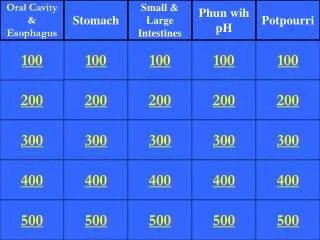
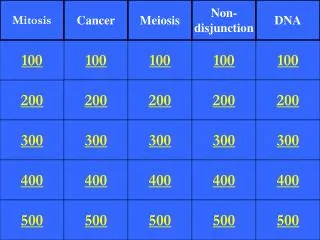
Mitosis Cancer Meiosis Non- disjunction DNA 100 100 100 100 100 200 200 200 200 200 300 300 300 300 300 400 400 400 400 400 500 500 500 500 500
If you break a leg, this process will return your muscle and bones cells and tissues to normal.
What is mitosis? 100 Mitosis
What is asexual reproduction? 200 Mitosis
What is a diploid cell? 300 Mitosis
This type of reproduction is favoured when the environment is unstable.
What is sexual reproduction? 400 Mitosis
What is programmed cell death? 500 Mitosis
What is a tumour? Cancer 100
What is damage? Cancer 200
A tumour that remains small and doesn’t spread is called this.
What is a benign tumour? Cancer 300
This is when a cancer cell from a tumour enters the blood and starts a tumour somewhere else.
What is metastasis? Cancer 400
These are the two main differences between cancer cells and normal cells going through mitosis.
Cancer cells are uncontrolled and divide faster, normal cells are carefully controlled and divide slower. Cancer 500
What is metaphase I? Meiosis 100
What is chromosomes split and the pieces of DNA move to opposite ends of the cell? Meiosis 200
What is 4 haploid cells? Meiosis 300
The pair of chromosomes that cross over in prophase I are called this.
What are homologous chromosomes? Meiosis 400
What is to create sperm and egg cells? Meiosis 500
What is chromosomes don’t split up. Non-disjunction 100
A child has 45 chromosomes. In what stage of meiosis did the problem occur?
What is anaphase I or II? Non-disjunction 200
This chart shows all your chromosomes lined up biggest to smallest.
What is a karyotype chart? Non-disjunction 300
What is XY? Non-disjunction 400
This disorder occurs when there are 3 copies of the number 13 chromosome.
What is trisomy 13? Non-disjunction 500
What are nucleotides? 100 DNA
Hair colour, eye colour, height are three examples of these.
What are genes? 200 DNA
What is information to make the specific trait (or alternate forms of a gene)? 300 DNA
If you have 2 different alleles for a gene, you are called this.
What is heterozygous or hybrid? 400 DNA