

SlideServe
Menu
Préférences
© SlideServe · v2026

Soil Morphology

rania avatar
20 diapositives · 1.3K Views · Aug 17, 2014

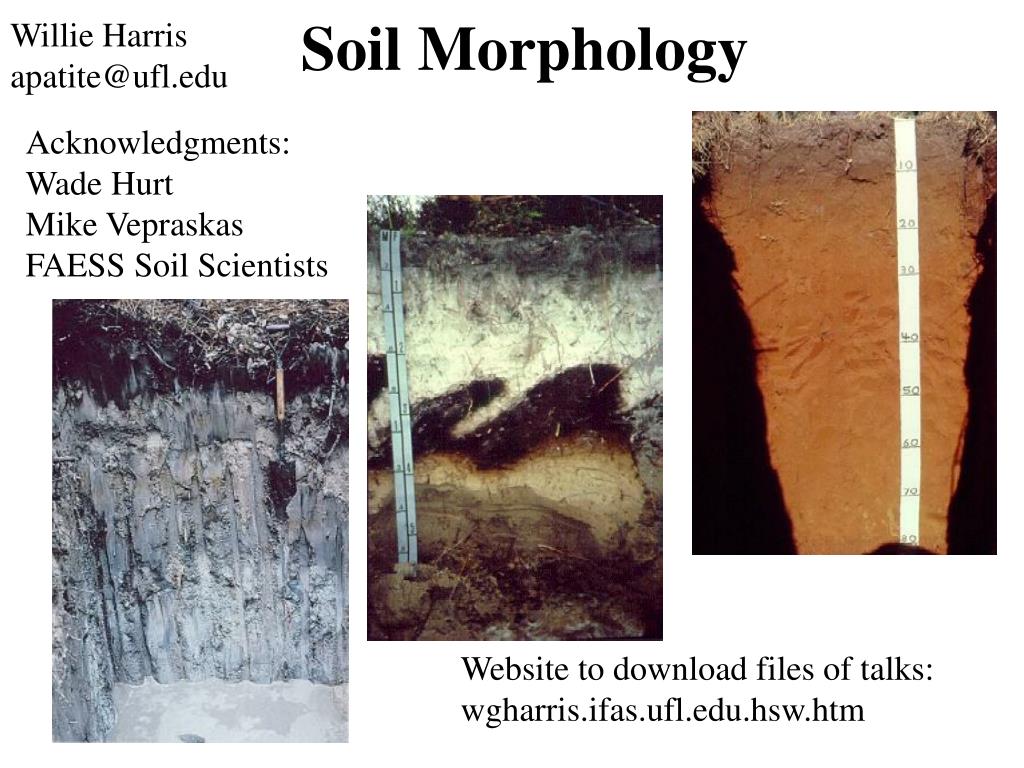
Willie Harris apatite@ufl.edu. Soil Morphology. Acknowledgments: Wade Hurt Mike Vepraskas FAESS Soil Scientists. Website to download files of talks: wgharris.ifas.ufl.edu.hsw.htm. Properties used in describing soil layers. a. Color: A key property in hydric soil interpretation.
Soil Morphology - slide 1
01 / 20Soil Morphology
1 / 17

Télécharger la présentation

Soil Morphology
Une image / un lien ci-dessous est fourni (tel quel) pour télécharger la présentation

Politique de téléchargement : le contenu du site vous est fourni TEL QUEL pour votre information et votre usage personnel ; il ne peut être vendu, concédé sous licence ni partagé sur d’autres sites sans l’accord de son auteur.Le contenu vous est fourni TEL QUEL, pour votre information et votre usage personnel uniquement. Téléchargez la présentation en cliquant sur ce lien. Lors du téléchargement, si vous ne parvenez pas à télécharger une présentation, l’éditeur a peut-être supprimé le fichier de son serveur.Pendant le téléchargement, si vous ne parvenez pas à obtenir une présentation, le fichier a peut-être été supprimé par l’éditeur.

F I N

Plus de contenu associé

Transcription de la présentation
  1. Willie Harris apatite@ufl.edu Soil Morphology Acknowledgments: Wade Hurt Mike Vepraskas FAESS Soil Scientists Website to download files of talks: wgharris.ifas.ufl.edu.hsw.htm

  2. Properties used in describing soil layers a.Color: A key property in hydric soil interpretation • Most evident • Influenced by OM and redox-sensitive metals • Wetness affects OM and redox-sensitive metals

  3. Color is described using the Munsell Color Book Here, the book is opened to the 10R Page …

  4. Hue: Related to Wavelength Value: Related to reflectance Chroma: Degree of spectral purity

  5. Here, the book is opened to the 10YR Page … Notation works Like this: yellowish brown (10YR 5/6) value hue chroma

  6. Hue Red 0 2.5R 5R 7.5R 10R Yellow-Red 0 2.5YR 5YR 7.5YR 10YR Yellow Hues highlighted in yellow are the common soil hues. 0 2.5Y 5Y 7.5Y 10Y

  7. Value • 10/0 - Pure White • 5/0 - “Gray” • 0/0 - Pure Black The Lightness or Darkness of Spectral Color

  8. Chroma “Neutral” Color “Pure” Color /0 /2 /4 /6 /8 Increasing strength of color Increasing grayness

  9. Reading Soil Colors • Optimum conditions • Natural light • Clear, sunny day • Midday • Light at right angles • Soil moist

  10. Contrast of Colors • Contrast refers to the degree of visual distinction between associated colors. • Faint-- evident only on close examination • Distinct-- readily seen • Prominent-- contrast strongly • Hydric soil indicators specify distinct or prominent.

  11. Abundance and Size of Color Contrasting Areas • Few -- less than 2% • Common -- 2 to 20% • Many -- more than 20% • Fine -- < 5 mm • Medium -- 5 to 15 mm • Coarse -- > 15 mm • Abundance more important for Hydric Soils

  12. b. Texture - proportions of sand, silt, and clay • The mineral component is usually described by it’s texture. Soil texture refers to the relative amounts of the variously sized soil separates. Where: • Gravel and larger fragments are >2 mm in diameter. • Sand is 2 -0.05 mm in diameter. • Silt is 0.05 to 0.002 mm in diameter. • Clay is < 0.002 mm in diameter.

  13. Relative Sizes of Soil Particles Sand (0.05-2.00 mm) Silt (0.002-0.05 mm) Clay (<0.002 mm)

  14. USDA Textural Classes - Defined by “textural triangle”

  15. c.Structure: Way soil particles aggregate into larger units with planes of weakness between them. Individual aggregates called peds. Common surface structure is granular: small spheroids Examples of common subsurface structure: Prismatic or Columnar Blocky Platy

  16. Soil horizons are layers formed via soil processes Soil Horizon Designations Master Horizons O – High organic matter content; “organic soil material”! A – Enriched in organic matter content; but not “organic soil material”! – At surface or below O – May be an “A” if disturbed (e.g., plowing) E – Loss of fine-textured components; “eluviation” – Characterized by clean sand, light color (high value, low chroma) B – Accumulation of components translocated from above – In-situ accumulation of metal oxides – Other in-situ gains and losses C – Little or no alteration; rock structure often evident R – Rock

  17. Transition Horizons

  18. Subordinate Distinctions within master horizons • Convey information about soil genesis and disturbance • Designated by lower case. EX: Bt, Bw, Ap • Important ones for Florida: • Ap - plowed or disturbed surface • Bt - illuvial accumulation of clay • Btg - illuvial clay + iron reduction or depletion • Bh - illuvial accumulation of aluminum and carbon • Oi - fibric organic soil material • Oe - hemic organic soil material • Oa - sapric organic soil material

  19. Horizon Boundaries

  20. Bringin’ it all back home A - 10YR 3/1; sand; cw boundary E1 - 10 YR 5/2; sand; gw boundary E2 - 10 YR 7/1; sand; as boundary Bh - 5 YR 2/1; sand; gw boundary Btg1 - 10 YR 5/2; sandy clay loam; gw boundary; blocky structure Btg2 - 10 YR 6/2; sandy clay loam; blocky structure