Diverse Biomes of the World: Adaptations, Locations, and Wildlife
Explore various biomes like Tundra, Boreal Forest, Rainforest, Grassland, Desert, and Polar Ice, learning about unique adaptations of plants and animals to survive in these environments.

Diverse Biomes of the World: Adaptations, Locations, and Wildlife
E N D
Presentation Transcript
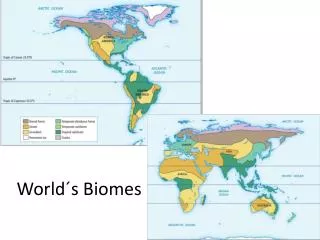
Tundra Location: upper northern hemisphere 60°-70° Climate: less than 25cm of precipitation annually, summer 3°C to 12°C, winter -20°C to -30°C Physical features: permafrost Plant adaptations: plants grow close to the ground. Shrubs, short grasses lichens and mosses Animal adaptations: animals have compact bodies. Grow slowly and reproduce less--- less energy needed Photograph by Rich Reid, National Geographic
Boreal Forest Location: northern hemisphere 45°-65° Climate: 30 cm to 85 cm precipitation annually (mostly snow) Physical features: terrain is rough, marshes, shallow lakes , soil is wet Plant adaptations: mainly coniferous trees (have cones), evergreen trees, waxy leaves Animal adaptations: small mammals burrow in winter, insulating coats, reptiles and amphibians are rare
Temperate Deciduous Forest Location: 23.5° north latitude, 23.5° and 38° south latitude Climate: 75 cm to 180cm or rainfall, -30°C to 30°C Physical features: large seasonal changes, 4 distinct seasons, enriched soil Plant adaptations: plants go in 4-5 layers, deciduous tress shed leaves, thick bark Animal adaptations: some mammals hibernate, many birds migrate south
Temperate Rainforest Location: 38°-61° north latitude, 38° - 56° south latitude Climate: rainfall exceeds 200cm a year, 5°C to 25°C, coastal fog Physical features: narrow strips along coastlines backed by mountains, ocean winds bring lots of moisture Plant adaptations: very tall trees, mosses and lichens on trees National Geographic Animal adaptations: most animals live near forest floor for protection
Grassland (Temperate and Tropical) Location: temperate: above 23.5° north latitude, below 23.5° south latitude; tropical:5°to 20 ° N and S of the equator Climate: temperate less rain than tropical; temperate winters are cold Physical features: land is mainly flat, soil rich and fertile Photograph by Phil Schermeister, National Geographic Plant adaptations: limited rainfall so few trees, roots are deep and plants regrow after fire, flexible stalks Animal adaptations: large grazing mammals , flat teeth
Tropical Rainforest Location: 4800km wide around the equator Climate: rainfall approx. 250cm per year, 20°C to 25°C all year Physical features: poor soil, dark forest floor Plant adaptations: largest number of different species, plants grow in may layers, leaves have narrow tips Animal adaptations: greatest diversity of animals on earth, most animals live in trees Photograph by Timothy G. Laman, National Geographic
Desert (Hot and Cold) Location: hot deserts on every continent, cold deserts in dry regions in the interior of continents Climate: rainfall less than 25cm annually; hot deserts: hot days, cold nights; cold deserts: warm summer days, cold winter days Physical features: soils are often salty Plant adaptations: roots extend metres away from the plant to absorb water, thick waxy leaves Animal adaptations: hot deserts: reptiles thick skin and scales; cold deserts: animals burrow
Permanent Ice (Polar Ice) Location: polar land masses and polar caps of the Arctic, Greenland, and Antarctica Climate: annual precipitation (snow) less than 50cm; -30 to 14°C Physical features: very strong winds, little soil Plant adaptations: lichens (fungi and algae) tolerate drought and cold, some mosses, brief growing season in Arctic Animal adaptations: thick coats and fat layers for warmth