MOTION
This comprehensive guide delves into the concept of motion, defined as the change in position of an object in relation to a reference frame. Explore the differences between displacement and distance, and learn about the three primary states of motion: at rest, constant velocity, and acceleration. Get insights into key terms like speed (the rate of distance covered) and velocity (speed in a specific direction), along with their equations and units. The guide also touches on the relative nature of motion and provides useful resources for further exploration.

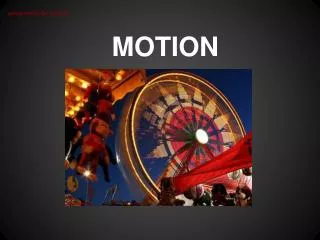
MOTION
E N D
Presentation Transcript
MOTION speed, velocity and acceleration
Motion Notes— • What is motion? • Motion is relative • Displacement vs. Distance • Constant vs. Changing Motion • Three possible motions
What is Motion? • Motion occurs when an object changes position • The position of the object depends on your frame of reference. • A frame of reference refers to the stationary background to which the object’s position is compared.
Motion is relative • Motion is relative to a chosen frame of reference. • You at rest at your table…are you moving? • Relative to the floor? • Relative to the school building? • Relative to the ground? • Relative to the Sun? • Relative to the Galaxy? • Relative to the Universe? • http://www.phy.ntnu.edu.tw/java/relativeVelocity/relativeVelocity.html • http://www.classzone.com/books/ml_science_share/vis_sim/mfm05_pg7_relmotion/mfm05_pg7_relmotion.html
Descriptions of Motion • Relative motion—motion of objects as perceived from your frame of reference • Linear motion—motion of objects moving in straight lines (opposite of non-linear) • Constant motion—motion of objects in mechanical equilibrium (no change in motion) • Changing motion—motion of objects that are accelerating
Displacement vs. Distance • Displacement is the distance and direction of an object’s final position from its initial position. • Distance is the length of the path that the object travels.
Three Possible States of Motion • At rest • Constant velocity (same speed and direction) • Acceleration (changing speed and/or direction)
Describing Motion • By definition • By comparison • By measurements • By equations • By graphs
SPEED IS… • HOW FAST AN OBJECT MOVES. • total distance covered divided by time it takes to cover that distance • Speed equation v = d/t • SI unit is meters/second (or m/s) • Example… 40 m/s
VELOCITY IS… • SPEED IN A GIVEN DIRECTION • Speed is determined by the speed equation • Direction of speed is described • SI unit is m/s and direction • example… 40 m/s east
ACCELERATION • The rate of change in velocity over a period of time. • SI unit is m/s2 • example… 4.5 m/s2 or - 4.5 m/s2 • Positive means speeding up, negative means slowing down • Velocity changes in two ways • #1: a change in speed (acceleration or deceleration) • #2: a change in direction (turning)
ACCELERATION EQUATION • Acceleration = final velocity – initial velocity final time – intial time a = vf - vi tf - ti
GRAPHING SPEED • Two types of graphs • Distance-time graphs • Velocity-time graphs
RELATIVE MOTION WEB SITES • http://www.phy.ntnu.edu.tw/java/relativeVelocity/relativeVelocity.html • http://www.physicsclassroom.com/mmedia/kinema/kinemaTOC.html • http://hyperphysics.phy-astr.gsu.edu/hbase/relmot.html • http://www.ii.metu.edu.tr/emkodtu/met106/lectures/motion_in_2_and_3d/page9.html
RELATIVE MOTION • Motion relative to your perspective or frame of reference. • In order to see an object in motion, you need a perspective or frame of reference, such as a stationary background, for comparison. RELATIVE MOTION