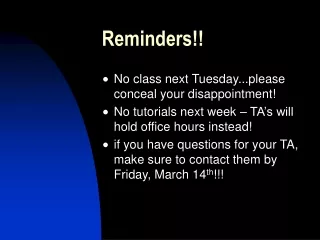
Reminders
Reminders. Rough draft due Thursday Peer group comments and whole class discussion of papers on Tuesday Please do not pack up and begin to leave before class is over. . Discussion of reading: What felt successful about the paper? How effective were uses rhetorical appeals?


Reminders
E N D
Presentation Transcript
Reminders • Rough draft due Thursday • Peer group comments and whole class discussion of papers on Tuesday • Please do not pack up and begin to leave before class is over.
Discussion of reading: • What felt successful about the paper? • How effective were uses rhetorical appeals? • Where could you locate contextual research?
Uses language” heck" and "darn" and "gosh" and "shoot" and "oh, gee." She says, "Guys and gals, our regulatory system is outdated." And: The nation's financial system "needs some shakin' up and some fixin.' " • She pronounces things "awesome" and "cool," as in: "He's an awesome bundle of joy" (baby Trig) and "It was so cool growin' up in this church and gettin' saved here” The critics -- she calls 'em "haters.
Kairos • the right time to speak/write; advantageous, exact, or critical time; a window of time during which action is most effective. • Good rhetors seize kairotic moments; they know when the time is “ripe” to speak or write. Stephen “took the floor” once his opponent stopped speaking.
Example • Palin’s "Drill, Baby, Drill"—that is, pursue more oil exploration off the coast of the United States—that particular line resonated with certain audiences during her 2008 presidential campaign. • Gas prices were high and people were focused on the need for the U.S. to reduce its dependence on foreign sources of oil. • BP oil spill happened in April 2010, politicians stopped using that line ... the meaning and connotative associations of “drill, baby, drill” changed dramatically
Rick Perry: Visual & Verbal • http://www.youtube.com/watch?v=R0n3NLgSsAg
Paper Development • Contextual: background, history, kairos, audience, scotosis • Textual: ethos, logos, pathos specifics • Evaluation: warrants, effectiveness, ethics
Contextual • situation and background in which the piece of writing or speech appears. Questions: what, when, where, how, from whom, to whom, and why. • Do secondary research to determine things like: • Who is the speaker? • How well did the audience know the speaker/writer? • Where did the writing appear; where was the speech given? • What were the hot issues and matters of significance at the time? • What information is missing? Scotosis?
Contextual cont. • Audience: identifying assembled audiences for the speaker or writer: Who will read it? Who will hear it? • More importantly: • Who is the speaker/writer trying to persuade? • What attitude or position is she/he addressing? • What change in the audience is she/he trying to effect? • Possibility of multiple of audience
Evaluation • Effectiveness (changes audience) • Appropriateness (for audience, occasion). • Interesting, compelling (stylistically riveting, emotional, humorous, interesting) • Quality of production • Honest/accurate, ethical. No manipulation of audience. • Knowledgeable, insightful. Speaker has an excellent grasp of the topic.
Group brainstorming • Take 5-7 minutes to analyze your topic • Find examples of ethos, pathos, logos. Consider warrants and claims. • Begin thinking about contextual and textual support and begin drafting an outline • Use handout on the wordpress to think your topic and organization.
Homework • Write rough draft • Post to Niikha before class on Thurs. • See handout under Readings on the Wordpress for additional help.