Download
1 / 61
620 likes | 738 Vues
Discover the intricate geography of the Indian subcontinent and how it influenced ancient civilizations, including the Indus Valley, known for its planned cities and advanced engineering. Examine the impact of the Aryan migration around 1500 BC, leading to significant cultural changes and the emergence of the caste system. Explore the roots of Hinduism, its beliefs, gods, and core principles, as well as the historical significance of the Mauryan Empire. This overview provides insights into the fusion of ancient cultures and the development of societal structures.

E N D
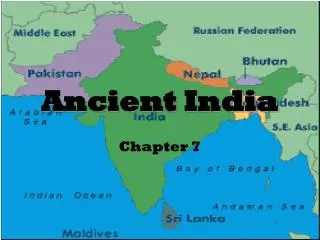
The Geography • On which continent is India located? • Asia; India is a subcontinent of Asia
The Geography • Indian subcontinent: landmass that includes India, Pakistan, & Bangladesh, Nepal, Sri Lanka, & Bhutan
The Geography • World’s tallest mountain ranges separate it from the rest of Asia • Mountains to the north & desert to the east help protect Indus Valley from invasion
The Geography • On which river(s) did the ancient Indians settle? • The Indus & Ganges Rivers which form flat, fertile plains
Earliest Arrivals • About 7000 BC, evidence of agriculture & domesticated animals; by 3200 BC, people farming in villages along Indus River
Planned Cities • By 2500 BC, people build cities of brick laid out on a grid system • Indus valley called Harappan civilization after Harappa, a city • Mohenjo-Daro is another city on Indus
Planned Cities • Engineers create plumbing & sewage systems • Lanes separate rows of houses - which featured bathrooms!
Thinking Question… • What does the city planning and attention to plumbing and sewer systems tell us about this ancient culture?
Harappan Culture • Language: • Had writing system of 400 symbols, BUT scientists can’t decipher it
Harappan Culture • Role of religion: • priests closely linked to rulers • some religious artifacts reveal links to modern Hindu culture • Trade: • had thriving trade with other peoples, including Mesopotamia
Harappan Decline • Signs of decline begin around 1750 BC • Earthquakes, floods, soil depletion may have caused decline • Around 1500 BC, Aryans enter area & become dominant…
About 1500BC, Indo-European people called the Aryans migrated into the Indus Valley region The Clashing of Cultures
The Aryans: Were male dominated nomadic tribes Herded animals (cattle) Were warriors Had nowritten language The Clashing of Cultures
The Clashing of Cultures: • From the clash of these two cultures came: • Religious Writings • Distinct Social Structure; the CASTE system • Hinduism
Religious Writings • The VEDAS: • “Books of Knowledge” • Songs & prayers of the Aryans – passed down through oral tradition
The Caste System • Aryans were physically distinct from people of India (lighter skin, taller) • 4 castes, or groups based on occupation, develop to separate Aryans & non-Aryans
Brahmins: Priests Kshatriyas: Rulers & Warriors Vaishyas: Traders & Landowners, Merchants Sudras: Laborers & Servants Caste System Untouchables:Outcasts = outside caste system
Thinking Question: • What do these body parts indicate about each of the 4 major castes?
The Caste System • People are born into their caste for life; hundreds of subgroups arise later • Members of higher castes were considered more pure
People outside the caste system: the Untouchables! Considered spiritually polluted; ignored by members of other castes The Caste System
Thinking Question… • Even though castes were separated in society, different castes lived together in the SAME village – Why?
The Caste System • If you were obedient to the restrictions of your caste, you would be reincarnated into a higher caste
Hinduism The Beginnings…
The Beginnings • Hinduism: a collection of religious beliefs that developed slowly over time • No one founder
The Beginnings • 750-500 BC Hindu teachers tried to interpret and explain meanings of Vedic hymns • Create Upanishads - texts of religious teachings
Hindu Gods • Brahman: • Supreme god and universal world soul
Hindu Gods • Hindus believed that Brahman was too complex a concept for humans to understand • Worshipped gods & goddesses who served as links to Brahman
Brahman One Divine Essence Unity Gods - Many manifestations of Brahman Brahma The Creator Vishnu The Preserver Shiva The Destroyer Hindu Gods + millions of other gods
Major Hindu Beliefs • Each person has atman – individual soul • Goal in life is to unite atman (individual soul) with Brahman (world soul) • How?...
Major Hindu Beliefs • Reincarnation: • The cycle of rebirth; people born to new lives • Karma: • Every action is punished orrewarded which determines course of new life
Major Hindu Beliefs • Dharma: • One’s moral duty in life; varies according to caste, gender, etc. • How might this reinforce the caste system??
Major Hindu Beliefs • Moksha: • State of perfect understanding = freedom from rebirth • Union with Brahman achieved • Hindus choose own path to moksha
Impact of Hinduism • Hinduism spread throughout Indian subcontinent • Jainism– New religion 500s BC; will not harm any creature; practice religious tolerance
Mauryan Empire • Established in 322 BC by the great Indian military leader, Chandragupta Maurya
Mauryan Empire • Politically unites North India for the first time ever • Taxation supports huge army and creates highly effective gov’t
Asoka’s Reign • In 269 BC Asoka, Chandragupta’s grandson, becomes emperor
Asoka’s Reign • After many years of violent conquest, Asoka feels remorseful
Asoka’s Reign • Converts to Buddhism & rules by Buddha’s teaching of “peace to all beings” • SpreadsBuddhism throughout India & other parts of Asia via missionaries; but tolerant of other religions
Asoka’s Reign • Asoka’s Rock Edicts: Laws carved on rock pillars are placed throughout the empire • Stress concern for other human beings