Early Religions
170 likes | 197 Vues
Delve into the complexities of early religions, comparing polytheistic belief systems like Hinduism, Buddhism, Jainism, and Judaism. Uncover the diverse practices, doctrines, and cultures of these ancient faiths.


Early Religions
E N D
Presentation Transcript
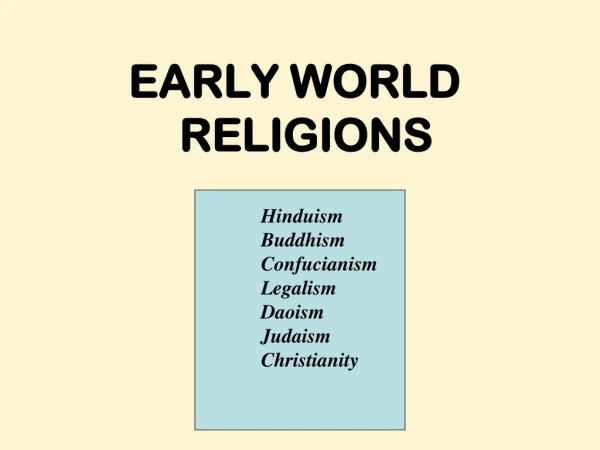
Early Religions Comparing Belief Systems
Polytheistic Religions: Hindu • Vedic Religions of India • Brought by the Aryans • Hinduism • Belief in a single force of ultimate reality (Brahma) • Created a Caste System • Castes are a class system where each person is born into a particular caste and cannot move outside of it for marriage, employment, etc. • Reincarnation: Become one with single force • Cycle of Birth, Life, Death, Rebirth • Karma: force generated by a person’s actions • Get what you deserve
Hinduism • Dharma • Divine Law states that all people must perform their duties • Legal and religious enforcement of Caste System • Castes are a class system where each person is born into a particular caste and cannot move outside of it for marriage, employment, etc. • Yoga • Achieve oneness with Brahman • Gods are an expression of Brahma
Polytheistic Religions: Buddhism • Buddha (Enlightened One) • Siddhartha Gautama 6th century prince • Nirvana • Enlightenment comes from achieving wisdom • Once enlightenment is achieved, reincarnation cycle ends • Appealed to lower class more than Hinduism • Rejected the Caste System • All were =
Polytheistic Religions: Buddhism • 4 Nobel Truths: • Life is Suffering • Cause of suffering is greed and/or desire • All suffering can be overcome • Follow the Eightfold Path to end suffering • Follow the 8 Fold Path (Middle Path)
Polytheistic Religions: Jainism • VardhamanaMahvira “Great Hero” • Last teacher • Died of starvation • 3 Jewels to gain enlightenment and purity of soul • Right Belief • Right Knowledge • Right Conduct • Mental, physical and verbal actions towards all living things • Satya • Truthfulness • Speak harmless truth • Asteya • Non-stealing • Do not take anything not properly given • Brahmacharya • Chastity • Do not indulge in pleasure • Ahimsa • Non-violence • Do not eat meat, fish, eggs, root vegetables or animal ingredients
Polytheistic Religions: Jainism • VardhamanaMahvira “Great Hero” • Last teacher • Died of starvation • 3 Jewels to gain enlightenment and purity of soul • Right Belief • Right Knowledge • Right Conduct • Mental, physical and verbal actions towards all living things
Polytheistic Religions: Jainism • Satya • Truthfulness • Speak harmless truth • Asteya • Non-stealing • Do not take anything not properly given • Brahmacharya • Chastity • Do not indulge in pleasure • Ahimsa • Non-violence • Do not eat meat, fish, eggs, root vegetables or animal ingredients • 2 Gods • Arihants: Perfect human beings guiding during life • Siddhas: Perfected souls living forever in bliss • Arihants become Siddhas in death
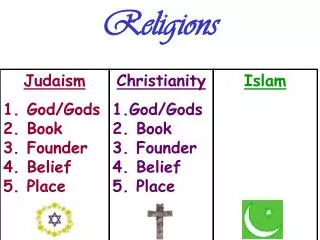
Monotheistic Religions: Judaism • People of the Kingdom of Judah (Jews) • founded around 2000 BC in Israel (Canaan). • Teaching • Based on the Teachings of Abraham • Covenant with a single God • God promised Abraham he would protect him and his descendants and give them the land of Israel. In return for this they promised to obey God • Law • Ten Commandments from God • Written down – Torah (Old Testament) 9
Monotheistic Religions: Judaism • Moses created the Torah around 1250 B.C. • The Torah contains the laws of God. • freed Jews from slavery in Egypt. • Protected the Jews from the wrath of God, negotiated on their behalf. • The symbol or emblem of the Jewish people is the Magen David (Shield of David), also known as the Star of David. • Worship in Synagogues. • Men and women usually sit separately in the Synagogues. • Men must cover their heads. • The Jewish spiritual leaders are called Rabbis. 10
Monotheistic Religions: Judaism • The most important day of the week is the Sabbath (Shabbat) • refraining from weekday work. • Including driving and cooking • Starts at sunset on Friday and continues until sunset on Saturday. • At the beginning of Shabbat families share a meal. 11
Monotheistic Religions: Zoroastrianism • Original Persian religion • Zoroaster (Zarathustra) –Persian Prophet • Unclear dating (1500-1000 BCE) • Belief that his birth was predicted and evil forces tried to kill him as a child • Official religion of the Persian Empire until the 7th century CE (Islam replaced it) • Recorded in the Avesta • Supreme god • Evil spirit • Heaven and Hell 12
Monotheistic Religions: Zoroastrianism • Ahura Mazda? • Does not have form; transcendent • Fravashi – The good part of the human soul given by Ahura Mazda at birth. • One hand upwards – striving for constant spiritual improvement • Ring in hand – loyalty and faithfulness • Circle – immortality of the soul; repercussions of our actions • Three rows of wing feathers – good thoughts, words, and deeds • Three sections tail feathers – the opposite • Two streamers – SpentaMainyu and AngraMainyu – spirits of good and evil – Figure faces one and turns from the other 13
Christianity • Jesus, a Jew, began to preach during the conflict. Taught: • Love God and each other • Values: humility, charity, love of others- shaped W. Civ. • Opponents handed him to Romans. • Crucified • Followers believed he overcame death. • Jewish followers believed he came to save Israel. • Recorded in the New Testament 14
Islam • Muhammad went to the hills to meditate about gap b/w rich and poor. • Built upon Judaism (Moses) & Christianity (Jesus). --- third prophet • Sacred text – Qur’an (Koran) • Name of God – Allah (Arabic for God) • Islam means “surrender” and “peace” • Muslims practice Islam 15
Five Pillars of Islam • Faith in One God • “There is no God but Allah and Muhammad is His Prophet” • Formal Periods of Worship • Prayer 5 times daily; directed toward Mecca • Almsgiving (Charity) • Usually 2.5% of one’s wealth • Fasting during Ramadan • Pilgrimage (Hajj) to Mecca 16
CHART • Create a chart in your notebook w/ the following: • 6 Rows • Hinduism, Judaism, Zoroastrianism, Buddhism, Christianity, Islam • 6 Columns • Origin (date), god(s), afterlife, beliefs, texts, impact* • Create another chart in your notebook w/ the following • 3 Rows • Confucianism, Daoism, Legalism • 4 Columns • Origin (date), beliefs, texts, impact* 17