Fungi
This article delves into the fascinating world of fungi, exploring their classification, reproduction methods, and ecological roles. Fungi, once categorized with plants, thrive in diverse environments and exhibit unique characteristics, such as cell walls and a complex network of hyphae. We discuss the four main types of fungi, focusing on Zygomycetes like bread mould and Club Fungi, which include mushrooms and bracket fungi. The reproductive mechanisms—both asexual and sexual—are highlighted, showcasing the remarkable adaptability of these organisms in various habitats.


Fungi
E N D
Presentation Transcript
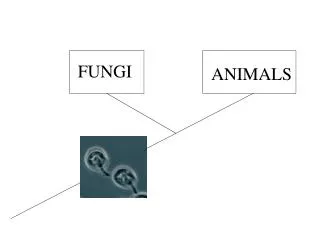
Classifying Fungi • Original ancestors unkniwn • Used to be included in plant kingdom • Grow in ground + have cell walls ( like plants) • Classified in 4
Zygomycotes • Includes: saprotrophs: absorbs nutrients from inanimate sources • Also: moulds, parasites of protists and small invertebrate animals • Small black dots • Reproduce both asexually and sexually • Keep sexual reproduction in reserve
Sexual Reproduction • Produce zygospores • Thick wall develops around the nuclei fuse to protect contents from dying • Zygospore is dormant until exposed to adequate growing conditions • Absorbs water and nuclei undergo meiosos
Bread Mould • Made up of two forms of hyphae • Stolons are horizontal hyphae. They spread over the bread surface • Rhizoids are downward growing hyphaepenetreate and anchor mycelium to bread • Rhizoids also secrete enzymes that digest surrounding food then absorb digested nutrients
Asexual Reproduction • Develop 3rd form of hyphae called sporangiophores that extend above the myclium • They carry sporangia ( sprore bearing capsulees) • Asexual Spores develop inside the sporangia • Then it is released when capsules split open
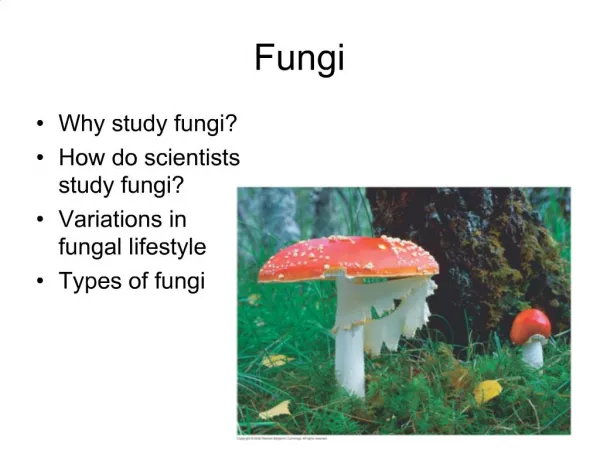
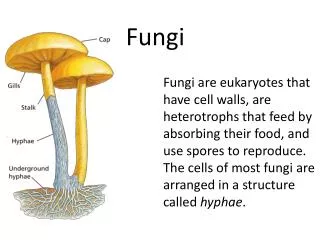
Club Fungi • Inlcude mushrooms that grow on lawns, bracket fungi on dead trees, puffballs and stinkhorns on woodland floors • Short lived reproductive structures called fruiting bodies or basidiocarps • Bear spores called basidospores located on club shaped hyphae called basidia • Some club fungi are parasites to plants and do not form basidiocarps
Club Fungi • mushrooms seen growing on ground not the whole thing vast network of hyphae spread underground • Basidiospores are releas and when they land on a suitab;e environment begins to grow and produce hyphae • 2 different types of hyphae
Repruction • Gills extend under the cap of the mushroom