Download
1 / 13
130 likes | 268 Vues
This report explores the current landscape of health insurance in Kenya, focusing on the National Hospital Insurance Fund (NHIF) and private insurance solutions. Key insights are provided by experts from various public and private sectors. The NHIF serves as a mandatory coverage option with limited benefits while private insurers cover a small portion of the population. The report highlights opportunities for expanding health insurance services, including new insurance models, regulatory reforms, and public-private partnerships aimed at improving access to healthcare for vulnerable populations.

E N D
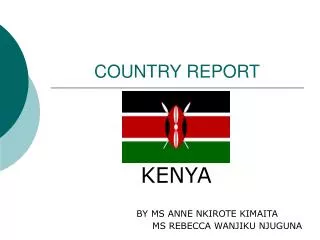
Country Report Out Kenya October 23, 2009
Kenya Your Ultimate Partner in Promotion of Health Insurance
Team Members • Geofrey Njoroge Kimani- Principal Economist, Ministry of Medical Services • Eunice Cherotich Kigen- Finance Officer, Ministry of Finance • Ayub Njoroge Mwando- Chief Economist, Ministry of Public Health and Sanitation • Dr. Nelson Gitonga- Senior Private Health Sector Expert • Peter Kimotho Ngure- Christian Health Association of Kenya/ HENNET • Dr. Amit Thakker- Kenya Private Health Sector Alliance (PPP Health Kenya) • Mentor: Netsanet Walelign- World Bank • Facilitator: Sarah Bittman- USAID/Washington
Current Health Insurance Health Financing • Public: • National Hospital Insurance Fund- est. 1966 • Run as a state corporation • Enrollment is mandatory by law for formal sector • Informal sector can join voluntarily • Financed through payroll deduction from employee on a sliding scale (no government or employer contribution) • High co-pay (thin benefits) • Reverse subsidy • Total coverage: about 20% of the population • High administrative expenses • NHIF has surplus funds • Management board composed of representatives of all stakeholders
Current Health Insurance Health Financing • Private: • Private insurance companies • Cover about 3% of the population • Kenya has close to 43 private insurance companies- 14 are medical • Most are employer-paid group schemes • 4 companies control close to 70% of the market • All members covered are already covered by NHIF • Medical Insurance Providers • Same characteristics as private companies, only more recent
Current Health Insurance Health Financing • Private continued • Others • Self-funded groups (employer-based schemes) • Employer carries whole risk • Mixed models/bank assurance • Layering benefit packages of micro-finance institutions with NHIF and selling to groups- e.g. Kenya Women's Finance Trust • Insurance Regulatory Authority established to regulate insurance providers (doesn't regulate NHIF)
Opportunities to expand / improve health insurance • NHIF beginning to pilot out-patient coverage and comprehensive benefits package • Exploring capitation as a mode of health finance • NHIF reforms • New Insurance Types: • Low Cost Private Insurance • Piloting delivering low-cost insurance through existing micro-finance mechanisms • Output-Based • Voucher system- engaging both public and private providers • Collaboration between German bank KFW and MoH
Opportunities to expand / improve health insurance • CBHI • New concept, needs to be explored • Small jamiibora sacco scheme • Provider-based plans • Mainly FBO, small private facilities providing affordable health coverage to formal sector • Strengthen National Health Service to care for poor and indigent • Structure is there; needs to be strengthened and made autonomous • New regulatory framework to embrace innovative ideas • New Health Schemes Act to reduce cost of entry, promote affordable health coverage
Opportunities to expand / improve health insurance • Health Care Financing Working Group has been started • Fully representative of all sectors • 5 Pillars: • NHIF • Need to maximize efficiency, add out-patient coverage • Regulatory Framework • Need to review health policy, health-related Acts to align with Vision 2030 document • Looking at the poor • Find a tool to identify them; work to expand coverage to them • Private-Public Partnerships • A mandate is to develop alternative health financing models • Health Management Training • Skilled HR component
Potential challenges or obstacles • Regulatory Issues • Outdated policy and legal framework • Financial systems • Fiscal governance and regulatory bodies • Inadequate financial resources for comprehensive universal health care • Political will is a challenge • Stakeholder consensus • Health system challenges • Availability of providers, distribution, quality • Poverty identification and targeting
Actions and next steps that we can take • Report back and debrief the authorities and working groups (private, FBO, government stakeholders) • Crystalize quick wins through consultative process (PPP) • Fast-track health policy and Acts review • Update Health Financing Framework (5 year strategy) with lessons learned here to strengthen roadmap
Actions and next steps that we can take • Continue building consensus through stakeholder dialogue • Hold stakeholder workshop similar to this one • Broad research initiatives • Create repository of health financing information • Health Financing issue in budget for 2010- 2013 • Raise with MTEF