EARTHQUAKES
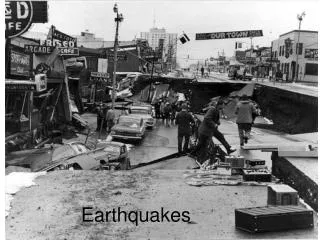
Earthquakes are powerful vibrations caused by the breaking of rocks in the Earth's lithosphere, primarily involving the crust and upper mantle. When the elastic limit of rocks is surpassed, they break and produce seismic waves that radiate outwards. Key concepts include fault types (normal, thrust, and slip), the focus vs. epicenter distinction, and the various seismic waves: primary (P-waves), secondary (S-waves), and surface (L-waves). Understanding the Richter and Mercalli scales helps assess earthquake magnitude and damage, respectively, crucial for disaster response.

EARTHQUAKES
E N D
Presentation Transcript
EARTHQUAKES Shaking Crust
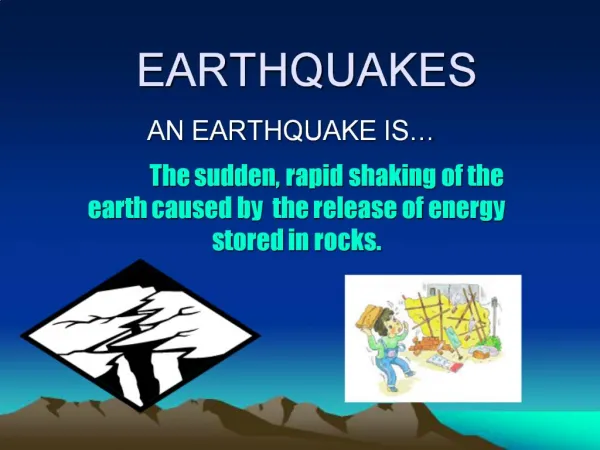
EARTHQUAKES • Vibrations produced by breaking of lithosphere (crust & upper mantle) • Elastic limit = amount that rocks can stretch and bend • When surpassed rocks break & move • Seismic waves (vibrations) sent out in all directions
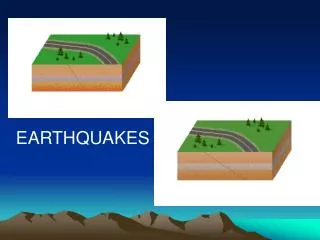
Fault • Surface along which rocks move
3 Types of Faults • Normal Thrust/Reverse Slip Fault Fault Fault
Focus vs. Epicenter • FOCUS – point below the surface where rocks actually break • EPICENTER – point on surface directly above the focus
Primary Seismic Waves • P wave • Longitudinal wave – particles move parallel to wave direction • Fastest • Least destructive
Secondary Seismic Waves • S wave • Transverse wave – particles move at right angles to wave direction • Slower than P waves • More destructive than P waves
Surface Waves • L wave • Particles move in ellipses compared to wave direction • Slowest • Most destructive
LAG TIME • LAG TIME = difference between first S wave and first P wave arrival at a seismic station • Longer lag time = further from the epicenter
Time-Travel Graph • Compares distance from epicenter to lag time
Seismograph Station-Locating an Epicenter • Triangulation-information from at least 3 seismic stations • Seismograph measures how much the surface of the earth moves • Draw 3 circles • Intersection = Epicenter
Richter Scale- Measures the Magnitude • Measures amount of energy released, magnitude • OBJECTIVE scale • NOT influenced by other factors • Used to compare earthquakes • Increase of “1” = 10 times more energy released
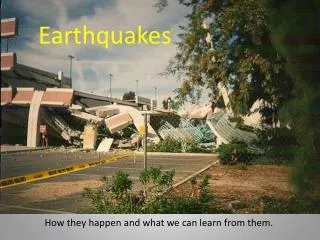
Mercalli Scale • Measures amount of damage done to man-made structures • SUBJECTIVE scale • Influenced by many factors (height of buildings, age, how built, etc. . .) • Used to determine amount of $$$ for aid
San Andreas Fault- edge of the Pacific plate is slipping past the North American plate
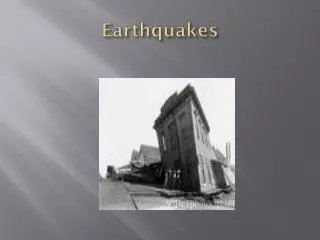
San Andreas Earthquake http://earthquake.usgs.gov/regional/nca/1906/18april/index.php
San Andreas Earthquake http://earthquake.usgs.gov/regional/nca/1906/18april/index.php