Understanding Public Opinion Polls and Sampling Methods
This lesson explores key concepts related to public opinion polls, including sample selection, random sampling, and sampling errors. Students will define essential terms such as exit polls, the gender gap, and civil disobedience. The course will analyze Figure 6.3 to understand voter participation trends, particularly why participation declines after age 70. The methods of conducting polls will be discussed, including pros and cons of random digit dialing, mail, and face-to-face surveys. The assignment involves creating and administering an opinion poll to gather insights on critical topics.

Understanding Public Opinion Polls and Sampling Methods
E N D
Presentation Transcript
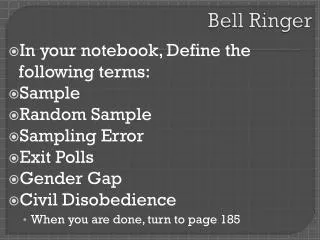
Bell Ringer • In your notebook, Define the following terms: • Sample • Random Sample • Sampling Error • Exit Polls • Gender Gap • Civil Disobedience • When you are done, turn to page 185
Public Opinion Polls How the Government Knows What It Knows
Analyzing Figure 6.3 What does this graph show? What is the trend that you see? Why do you think that voter participation declines around the age 70? What does the red line represent?
Conducting Polls • Someone read the first paragraph under “How Polls are Conducted” – Page 185 • So how it works: • You take a given population: let’s say America. Can you survey everyone in America? • Not effectively – So you get a sample • We generally want at least 1500 people • We want a random sample – everyone in the population has an equal chance of being selected. • How would we do this? • Most polls today are done through random digit dialing • Two other ways to conduct polls – via the mail and face to face • What would be some pros and cons to each method? • Think of the time they take, the accuracy, the cost and potential biases
Sampling Error What is this? How then can you avoid it? Can avoid sampling error by increasing the percentage of people polled
Exit Polls • Turn to page 188 – Someone read the paragraph about exit polls • Couple of Issues • People lie • Some people vote a “straight ticket” and have no idea who they voted for
Other Problems With Polling • Questions can be biased to get the answers that the pollster wants • Respected organizations (Gallup, Rassmusen)rarely do this • Example: • Do you support continued military action in Iraq and Afghanistan? • Do you think that America should leave Iraq and Afghanistan before the job is complete, essentially ensuring that the American soldiers who have died will have done so in vein? • Does one of these questions seem to have a bias?
Let’s look at a few polls • Look at Table 6.4 on page 193 • http://www.rasmussenreports.com/ • http://zogby.com/polls/latest/ • http://www.gallup.com/home.aspx • Gallup is more diverse • Generally need to have at least 1,500 participants for a poll to be valid
Political Participation • How can American’s participate in politics • Easiest way – Vote • What are some others • Protest • Civil Disobedience • what is this – Who made it famous in America? • Giving Money to a Candidate • Look at Figure 6.5 – page 200 • Running For Office • Writing a letter
Assignment – Due on Monday Create and administer an opinion poll Come up with 5 questions (minimum) to find out at least 5 people’s opinions about one of the following topics: The Economy, President’s Approval, Unemployment, Obamacare Then you answer the following questions: What is your population? What is the size of your sample? Is there a sampling error? Does your survey measure what you want it to? What do your results tell you?
Example Topic: Fraga’s Ability to Teach Question 1: Is Fraga a good teacher? Question 2: Have you learned anything? Q 3: Does Fraga know what he is talking about? Q 4: Do you feel confident that you will pass the AP test? Q 5: What President does Fraga Look like? Population: Seniors at DeSoto High School Sample: 20-ish students Sampling Error: Probably – Only have AP students. Also, the class I ask could be demographically different Validity: All but question 5 assess student’s opinion of Fraga’s teaching ability These results tell me that…