SlideServe
Menu
Préférences
© SlideServe · v2026

Bridging BioTop to Upper-Level Ontologies: Semantic Integration in Biomedical Domain

sheena avatar
1 diapositives · 120 Views · Aug 20, 2014

Explore the mapping and alignment of BioTop ontology to upper-level ontologies, addressing issues related to semantic types and relations. Learn about the bridging mechanism and rationale behind BioTop, consolidating domain ontologies with formal descriptions in biology and medicine.
Bridging BioTop to Upper-Level Ontologies: Semantic Integration in Biomedical Domain - slide 1
01 / 1Bridging BioTop to Upper-Level Ontologies: Semantic Integration in Biomedical Domain
1 / 17

Télécharger la présentation

Bridging BioTop to Upper-Level Ontologies: Semantic Integration in Biomedical Domain
Une image / un lien ci-dessous est fourni (tel quel) pour télécharger la présentation

Politique de téléchargement : le contenu du site vous est fourni TEL QUEL pour votre information et votre usage personnel ; il ne peut être vendu, concédé sous licence ni partagé sur d’autres sites sans l’accord de son auteur.Le contenu vous est fourni TEL QUEL, pour votre information et votre usage personnel uniquement. Téléchargez la présentation en cliquant sur ce lien. Lors du téléchargement, si vous ne parvenez pas à télécharger une présentation, l’éditeur a peut-être supprimé le fichier de son serveur.Pendant le téléchargement, si vous ne parvenez pas à obtenir une présentation, le fichier a peut-être été supprimé par l’éditeur.

F I N

Plus de contenu associé

Transcription de la présentation
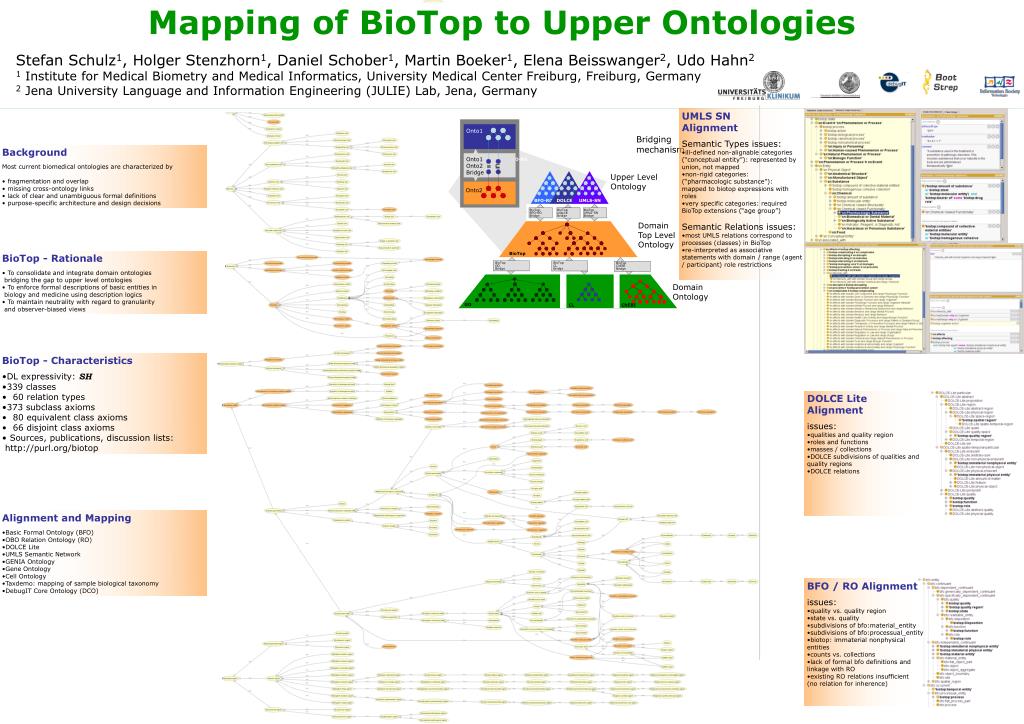
  1. Onto1 Onto1 Onto2 Bridge ⊑ ≡ Onto2 Mapping of BioTop to Upper OntologiesStefan Schulz1, Holger Stenzhorn1, Daniel Schober1, Martin Boeker1, Elena Beisswanger2, Udo Hahn21 Institute for Medical Biometry and Medical Informatics, University Medical Center Freiburg, Freiburg, Germany2 Jena University Language and Information Engineering (JULIE) Lab, Jena, Germany • UMLS SN • Alignment • Semantic Types issues: • ill-defined non-alignable categories(“conceptual entity”): represented by union, not mapped • non-rigid categories:(“pharmacologic substance”):mapped to biotop expressions with roles • very specific categories: required BioTop extensions (“age group”) • Semantic Relations issues: • most UMLS relations correspond to processes (classes) in BioTop • re-interpreted as associative statements with domain / range (agent / participant) role restrictions Bridgingmechanism • Background • Most current biomedical ontologies are characterized by • fragmentation and overlap • missing cross-ontology links • lack of clear and unambiguous formal definitions • purpose-specific architecture and design decisions BFO-RO Upper Level Ontology BFO-RO DOLCE UMLS-SN BioTop BFO-RO Bridge BioTop UMLS-SN Bridge BioTop DOLCE Bridge Domain Top Level Ontology BioTop • BioTop - Rationale • To consolidate and integrate domain ontologies bridging the gap to upper level ontologies • To enforce formal descriptions of basic entities in biology and medicine using description logics • To maintain neutrality with regard to granularity and observer-biased views BioTop GO Bridge BioTop CLBridge BioTop ChEBIBridge Domain Ontology GO CL ChEBI • BioTop - Characteristics • DL expressivity: SH • 339 classes • 60 relation types • 373 subclass axioms • 80 equivalent class axioms • 66 disjoint class axioms • Sources, publications, discussion lists: http://purl.org/biotop • DOLCE Lite • Alignment • issues: • qualities and quality region • roles and functions • masses / collections • DOLCE subdivisions of qualities and quality regions • DOLCE relations • Alignment and Mapping • Basic Formal Ontology (BFO) • OBO Relation Ontology (RO) • DOLCE Lite • UMLS Semantic Network • GENIA Ontology • Gene Ontology • Cell Ontology • Taxdemo: mapping of sample biological taxonomy • DebugIT Core Ontology (DCO) • BFO / RO Alignment • issues: • quality vs. quality region • state vs. quality • subdivisions of bfo:material_entity • subdivisions of bfo:processual_entity • biotop: immaterial nonphysical entities • counts vs. collections • lack of formal bfo definitions and linkage with RO • existing RO relations insufficient(no relation for inherence)