SlideServe
Menu
Préférences
© SlideServe · v2026

Understanding Upper-Level Winds: Dynamics of Atmospheric Pressure and Temperature

ron avatar
26 diapositives · 498 Views · Oct 20, 2014

Explore the dynamics of upper-level winds, focusing on atmospheric pressure, temperature, and wind patterns at various elevations. Discover how the gradient force influences stronger winds as altitude increases and how pressure varies with temperature changes. Learn about geostrophic winds, the significance of Rossby waves for midlatitude weather variability, and the role of jet streams in global atmospheric circulation. Understand how these elements contribute to weather conditions and patterns observed at the surface and higher altitudes.
Understanding Upper-Level Winds: Dynamics of Atmospheric Pressure and Temperature - slide 1
01 / 26Understanding Upper-Level Winds: Dynamics of Atmospheric Pressure and Temperature
1 / 17

Télécharger la présentation

Understanding Upper-Level Winds: Dynamics of Atmospheric Pressure and Temperature
Une image / un lien ci-dessous est fourni (tel quel) pour télécharger la présentation

Politique de téléchargement : le contenu du site vous est fourni TEL QUEL pour votre information et votre usage personnel ; il ne peut être vendu, concédé sous licence ni partagé sur d’autres sites sans l’accord de son auteur.Le contenu vous est fourni TEL QUEL, pour votre information et votre usage personnel uniquement. Téléchargez la présentation en cliquant sur ce lien. Lors du téléchargement, si vous ne parvenez pas à télécharger une présentation, l’éditeur a peut-être supprimé le fichier de son serveur.Pendant le téléchargement, si vous ne parvenez pas à obtenir une présentation, le fichier a peut-être été supprimé par l’éditeur.

F I N

Plus de contenu associé

Transcription de la présentation
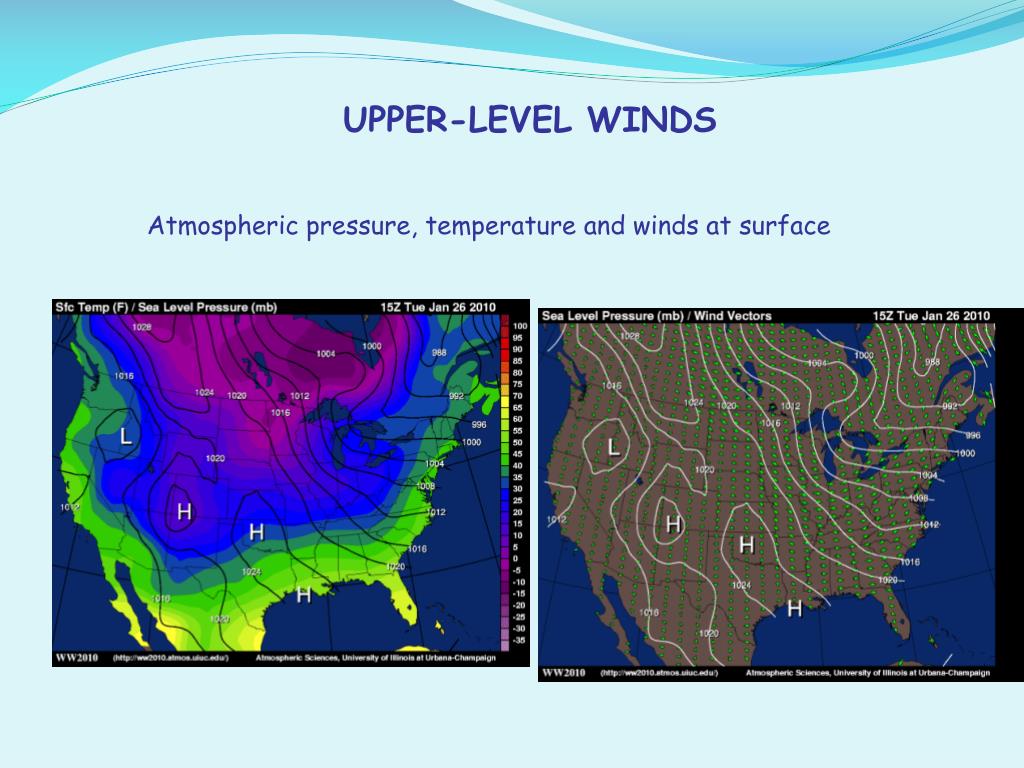
  1. UPPER-LEVEL WINDS Atmospheric pressure, temperature and winds at surface

  2. Weather conditions

  3. Atmospheric pressure and elevation

  4. Winds at upper level (500mb = ~5600 m of elevation or 18000 feet) 1 knot = 1 “nautical” mile/h 1 knot = 1.15 MPH 1 knot = 1.85 km/h

  5. Height and pressure at upper level (500mb = ~5600 m of elevation)

  6. Winds at upper level (200mb = ~11800 m of elevation)

  7. WINDS ALOFT How does air move at higher elevations? The gradient force INCREASES with altitude stronger winds How does pressure changes with elevation?

  8. H L H L L H 800mb warmer colder 850mb H4 800mb H3 850mb 900mb High Height H2 900mb Low Height 950mb H1 950mb Sea level 30° latitude POLE (90°) Pressure decreases with elevation: SLOWER in WARMER air FASTER in COLD air Height (of pressure): HIGH in WARMER air LOW in COLDER air Figure 5.17, Page 139

  9. 500mb

  10. GEOSTROPHIC WIND When the Coriolis force balances the gradient force. The speed and direction of wind remain constant It takes place at upper levels geostrophic wind

  11. GLOBAL CIRCULATION AT UPPER LEVELS • Weak equatorial easterlies (from ~ 25° to poles) • Tropical high pressure belts (15° -20°) • Upper air westerlies (from ~ 25° to poles, see undulations) • Polar low (See Fig 5.19)

  12. ROSSBY WAVES • Undulations of upper air westerlies • Formation: • Waves arise in region of contact between cold polar air and warm tropical air (Polar front)

  13. ROSSBY WAVES FORMATION 2. Warm air pushes pole ward and a tongue of cold air is moved to south (undulation development) 3. Waves are strongly developed. Cold air are “troughs” of low pressure 4. Waves are pinched off, forming cyclones of cold air

  14. ROSSBY WAVES • They are important for poleward heat transport • Reason for variable weather in midlatitudes

  15. JET STREAMS • Regions at high elevation with strong wind streams • According to the World Meteorological Organization we can call a “jet stream” any speed exceeding: • 67mph, 58 knots, 108 km/h • The core of jet streams reaches ~102mph • They take place where atmospheric pressure gradients are strong The greater the contrast in temperature, the stronger the jet streams blow

  16. JET STREAM • Polar jet stream • Follows the edge of Rossby waves. • Found at 10-12 km elevation (33,000-40,000 ft) • Wind speed: 75-125 m/s (170-280 mi/hr) • 2. Subtropical jet stream • In the subtropical latitude zone • Speed 100-110 m/s • 3. Tropical easterly jet stream • In summer season, over Asia, India, Africa, only in Northern Hemisphere Figure 5.21

  17. JET STREAMS • Jet streams tend to be weaker in summer than in winter • Jet streams are less intense in the Southern Hemisphere due to smaller land masses • Strongest jet stream have been recorded during winter over Southern Japan (speeds up to 310 mph)

  18. Wind at 200 mb (~12 km or 8 miles)

  19. Atmospheric pressure and temperature at surface (summer)

  20. Atmospheric pressure and winds at surface

  21. Winds at upper level (500mb = ~5600 m of elevation) http://weather.unisys.com

  22. Winds at upper level (200mb = ~11800 m of elevation)