SlideServe
Menu
Préférences
© SlideServe · v2026

Efficient Phagocytosis Assays Optimization for HIV Research

skyler-lane avatar
2 diapositives · 147 Views · Nov 20, 2014

This study details optimization of phagocytosis assays for HIV research, focusing on Env gp140 biotinylation and IgG concentration. Conditions for bead labeling, gating analysis, and optimal concentrations are discussed.
Efficient Phagocytosis Assays Optimization for HIV Research - slide 1
01 / 2Efficient Phagocytosis Assays Optimization for HIV Research
1 / 17

Télécharger la présentation

Efficient Phagocytosis Assays Optimization for HIV Research
Une image / un lien ci-dessous est fourni (tel quel) pour télécharger la présentation

Politique de téléchargement : le contenu du site vous est fourni TEL QUEL pour votre information et votre usage personnel ; il ne peut être vendu, concédé sous licence ni partagé sur d’autres sites sans l’accord de son auteur.Le contenu vous est fourni TEL QUEL, pour votre information et votre usage personnel uniquement. Téléchargez la présentation en cliquant sur ce lien. Lors du téléchargement, si vous ne parvenez pas à télécharger une présentation, l’éditeur a peut-être supprimé le fichier de son serveur.Pendant le téléchargement, si vous ne parvenez pas à obtenir une présentation, le fichier a peut-être été supprimé par l’éditeur.

F I N

Plus de contenu associé

Transcription de la présentation
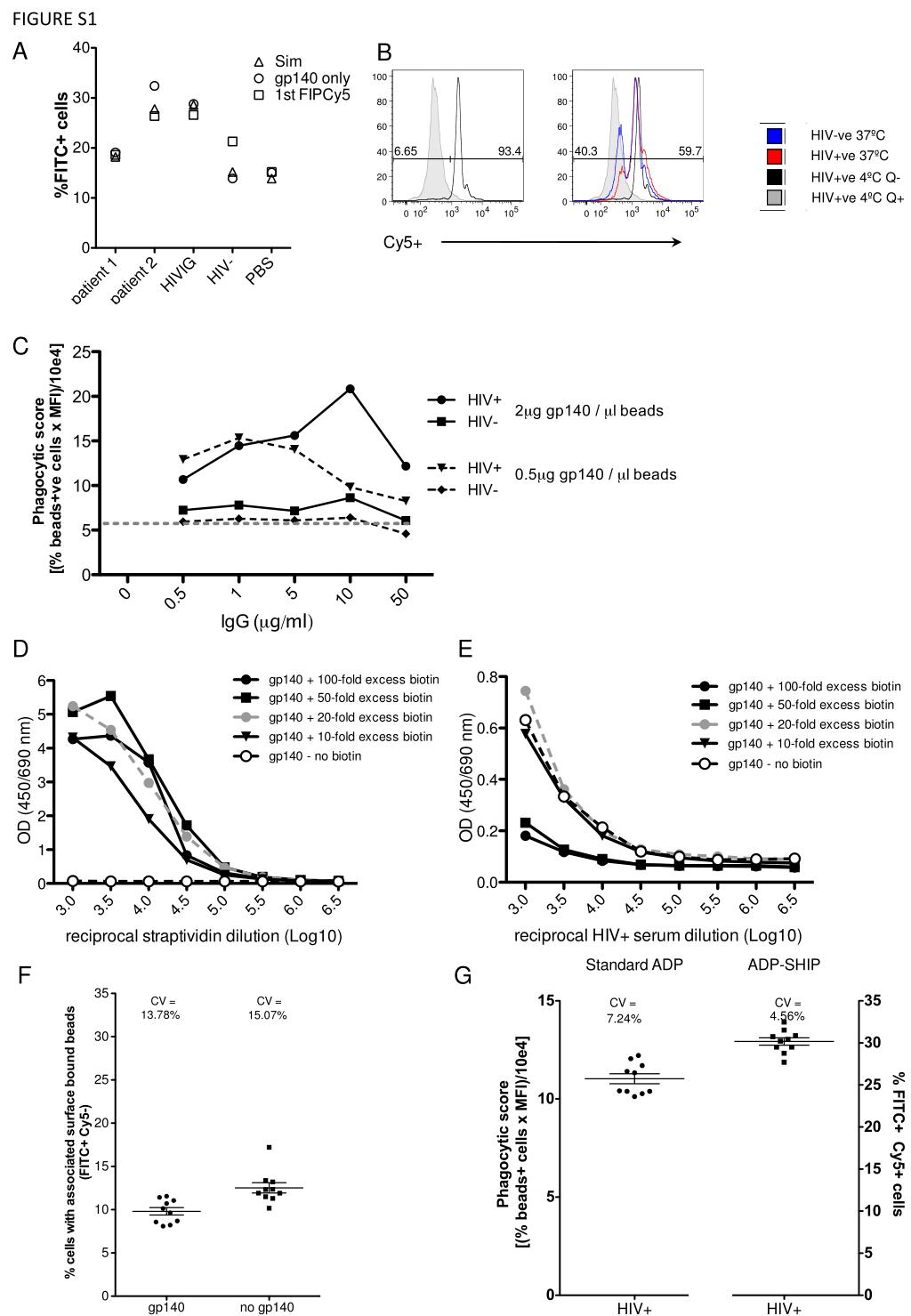
  1. FIGURE S1 A B HIV-ve 37ºC HIV+ve 37ºC HIV+ve 4ºC Q- HIV+ve 4ºC Q+ Cy5+ C D E F G

  2. Figure S1: Efficient phagocytosis in both ADP assays is highly dependent on optimal HIV Env gp140 biotinylation and Env gp140 concentration and IgG concentration. (A) Comparing coating conditions of fluorescent beads were tested for both ADP assays. The beads were labelled using three different conditions (i) adding FIPcy5 and 0.75μg gp140 at the same time (sim), (ii) adding FIPcy5 first before adding 1.5μg gp140 (gp140 in excess), and (iii) adding 1.5 μg gp140 (gp140 in excess) only as a control. patient 1 and patient 2: IgG from two HIV+ individuals; HIVIG: pooled HIV human immunoglobulin; HIV-: IgG from a pool of HIV- subjects; PBS: no IgG added. (B) Gating for internalised and surface bound beads was established performing the assay at 4˚C (no phagocytosis; binding only) and 37˚C (phagocytosis) using HIV+ and HIV- IgG. Q+: QPC added; Q-: QPC not added. (C) Optimal gp140 and IgG concentration was determined using the standard ADP and gp140 (shown here for subtype A/E (966)). Grey line represents background detected for non-opsonised beads (without IgG). Biotinylation of gp140 was performed with 10 to 100 fold molar excess biotin based on the manufacture’s recommendations. (D) Optimal concentration of biotin for maximum biotinylation was determined by ELISA using streptavidin. (E) The degree of masking immunogenic epitopes on gp140 by attached biotin at varying levels of excess biotin was determined by using ELISA and pooled HIV+ serum. F) Levels of surface-associated beads in the presence and absence of gp140 coating of beads. Ten replicates were studied in the absence of sera and the co-efficient of variation (CV) is noted on the graph. G) Reproducibility of the standard ADP and ADP-SHIP assays. Ten replicates of a single HIV+ IgG sample were assessed by both assays and the CV is shown for both assays.