
Sequential Circuits and Registers: Types and Applications
E N D
Presentation Transcript
7. Sequential circuits, 2nd part • Objectives: To recognize and know to use the principal types of sequential circuits • Registers • Counters • Generators of imposed sequences
Registers • Are sequential circuit capable of storing information of several bits (word). • Made of a set of flip-flops of the same type, driven by the same clock pulse. • There can be external gates to control the inputs of the flip-flops.
4 bits Register with D flip-flops
Registers (II) • Contents: series of bits • Length: a number of flip-flops • The flip-flops used usually transition on the clock pulse (ascending or descending). • Any sequential circuit can be made up of registers!
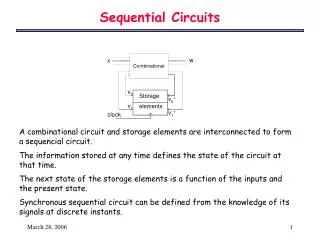
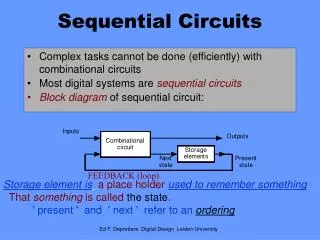
Registers (III) • A register preserves the state! Value of the next state Register (state) Combinational Circuit C Inputs Outputs
Realization with register & ROM • Design the following sequential circuit using a ROM and of a register • A1(t+1)(A1,A2,x) = A1x’ • A2(t+1)(A1,A2,x) = A2 Åx’ • y(A1,A2,x) = A2 x • Let us find the canonical SOP form = Sm(4, 6)= Sm(1, 2, 5, 6)= Sm(3, 7)
Realization with register & ROM • 8x3 ROM and 2 bits registers (D flip-flops ) D1A1 Q1 D2A2 Q2 ROM8x3 0 22 21 1 x 20 2 y C
Current State Input Next State Output A A x A A y 1 2 1 2 0 0 0 0 0 1 0 1 0 0 1 1 1 0 0 1 0 1 1 1 0 1 1 1 Calculation of the following state and y Transition Table
Current State Input Next State Output A A x A A y 1 2 1 2 0 0 0 0 0 0 0 0 1 0 1 0 0 1 0 0 1 0 0 1 1 0 0 1 1 0 0 1 0 0 1 0 1 0 1 0 1 1 0 1 1 0 1 1 1 0 0 1 Calculation of next state and y Transition Table
Adresses Output 2 1 0 2 2 2 0 1 2 0 0 0 0 0 1 0 1 0 0 1 1 1 0 0 1 0 1 1 1 0 1 1 1 Programming of the ROM Programming Table
Adresses Output 2 1 0 2 2 2 0 1 2 0 0 0 0 0 0 0 0 1 0 1 0 0 1 0 0 1 0 0 1 1 0 0 1 1 0 0 1 0 0 1 0 1 0 1 0 1 1 0 1 1 0 1 1 1 0 0 1 Programming of the ROM * Count of transition just as it is!!!(with D flip-flopsonly)
Several types of registers… • Shift registers • one-way (left or right-hand side) • bidirectional • Shift registers with loading • series or parallel • Built with RS, D, T, JK flip-flops … • From 1, 2, 3, 4, 8, 16… N bits
Counters • Goes through a predetermined sequence of states. • Made up of flip-flops . • Useful in counting, the division of frequency of clock, and in the generation of unspecified sequences.
Counters (II) • They have various characteristics: • Coding • binary, decimal, modulo M… • Mode • Asynchronous (ripple counter) • synchronous (all on the same clock signal) • With loading (or not) • Self-correcting (or not)
Additional readings • In Mano and Kime: • Sections 5.1 to 5.3: registers • Sections 5.4 to 5.6: counters • Sections 7.1 to 7.5: transfer between registers