Download
1 / 13
130 likes | 242 Vues
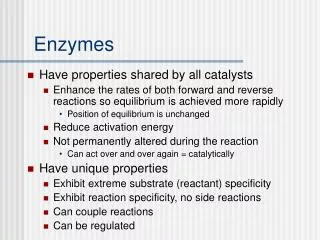
Enzymes are proteins that act as catalysts, accelerating chemical reactions in living organisms without altering themselves. They work by interacting with substrates at their active sites, forming enzyme-substrate complexes that facilitate reactions. Various factors affect enzyme activity, including pH, temperature, and substrate concentration. Enzymes are vital for countless bodily functions, and each operates optimally under specific conditions. Additionally, inhibitors can affect enzyme function by competing with substrates. Learn more about these crucial biological components and their roles.

E N D
ENZYMES Biological Puzzle Pieces
REMEMBER: What is a Catalyst? • A chemical that increases the rate of chemical reactions without altering the products or being altered itself
A Little About Reactions… • Chemical reactions occur when molecules within a system collide • Adding thermal energy to a system increases kinetic energy • Thus, molecules move faster and increase chances of collision • CATALYSTS speed up reactions at LOW TEMPS, so additional energy is not needed!
ENZYMES • A protein catalyst that is found in LIVING THINGS. • Permit low-temperature reactions by reducing the amount of activation energy required. • Enzymes are denoted using “-ase” as their ending. • i.e. carbohydrases break down carbohydrates
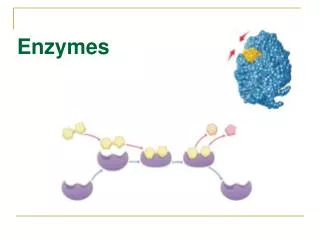
How Do They Work? • ENZYMES work on SUBSTRATES like a “puzzle piece” • Each substrate combines with a specific enzyme • Upon combination, the substrate changes and creates a new product • Estimated 200,000 different reactions in your body, each using a specific enzyme/substrate
How Do They Work? • “ACTIVE SITE” is the area of the enzyme that joins with the substrate. Imagine it as the “dock” • This creates the “Enzyme-Substrate Complex”
Co-Stars • COFACTORS:an organic ion that helps an enzyme combine with a substrate molecule • COENZYME: an organic molecule synthesized from a vitamin that helps an enzyme combine with a substrate molecule.
1. pH • Certain enzymes function most effectively at specific pH ranges. • i.e. PEPSIN: enzyme found in the stomach, works best at a low pH (b/c stomach is an acidic environment) • i.e. TRYPSIN: enzyme found in the small intestine, works best at a high pH (b/c intestine is a basic area)
2. Substrate Concentration • Because reactions happen due to collisions, higher numbers of substrates increase the likelihood of a collision between substrates and enzymes.
3. Temperature • As stated earlier… • Higher Temp. = Faster Reactions • BUT!!... • Why do reaction rates in human cells peak at 37 degrees?
3. Temperature Cont’d • At higher temperatures, proteins change shape or are denatured. • REMEMBER: Enzymes are PROTEINS • So, at certain temperatures, ENZYMES change their shape or are destroyed all together • This reduces the chance of enzyme-substrate combintation
4. Competitive Inhibition • INHIBITORS are very similar in shape to substrates • Thus, they bond with enzymes before substrates have a chance, reducing the function of the enzyme.