Download
1 / 29
290 likes | 395 Vues
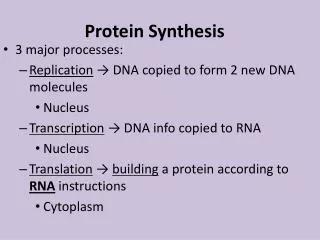
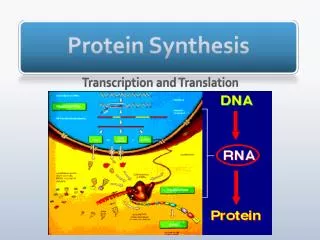
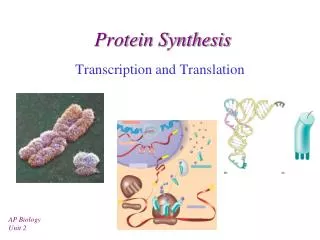
Protein synthesis is a fundamental biological process where cells produce proteins from genetic instructions. It involves two main stages: transcription and translation. Transcription occurs in the nucleus, where DNA is used to create messenger RNA (mRNA) with the help of RNA polymerase. This mRNA then exits the nucleus and enters the cytoplasm, where translation takes place at the ribosome. Here, transfer RNA (tRNA) helps assemble amino acids into polypeptides according to the mRNA's codon sequence, ultimately forming proteins that perform various functions within the cell.

E N D
Double stranded Sugar = deoxyribose Thymine (no Uracil) Stays in nucleus One type Same copy in the cell all the time Single stranded Sugar = ribose Uracil (instead of Thymine) Nucleus & cytoplasm 3 types (mRNA, tRNA, rRNA) Disposable copies DNA vs. RNA
RNA • many functions but mostly just protein synthesis • three main types of RNA: messenger RNA, ribosomal RNA, and transfer RNA
mRNA • RNA molecules that carry copies of the DNA instructions = mRNA • messenger RNA (mRNA) = serve as “messengers” from DNA to the rest of the cell
rRNA • Ribosomes are made up of several dozen proteins, as well as a form of RNA known as ribosomal RNA (rRNA).
tRNA • During the construction of a protein, a third type of RNA molecule transfers each amino acid to the ribosome • as specified by coded messages in mRNA. • These RNA molecules are known as transfer RNA (tRNA).
Transcription (DNA mRNA) • RNA molecules are produced by copying part of the nucleotide sequence of DNA into a complementary sequence in RNA • required enzyme = RNA polymerase • RNA polymerase binds to DNA (in nucleus) • separates the DNA strands • RNA polymerase then uses one strand of DNA as a template • nucleotides are assembled into a strand of mRNA • Transcription Animation
Where does RNA start? • enzyme will bind only to regions of DNA known as promoters • promoters are signals in DNA that indicate to the enzyme where to bind to make RNA (“start sequence”). • Similar signals in DNA cause transcription to stop when the new RNA molecule is completed.
RNA Editing • Intron = intervening sequence of DNA; does not code for a protein • Exon = expressed sequence of DNA; codes for a protein • When RNA molecules are formed, both the introns and the exons are copied from the DNA • introns are cut out of RNA molecules while they are still in the nucleus • exons are then spliced back together to form the final mRNA
The Genetic Code • Proteins = long chains of amino acids (polypeptides) • polypeptide = combination of any or all of the 20 different amino acids • properties of proteins are determined by the order in which different amino acids are joined together to produce polypeptides
The “language” of mRNA instructions is called the genetic code • RNA contains four different bases: A, U, C, and G • Letters read “3” at a time = codon • Codon = a group of three nucleotides on messenger RNA that specify a particular amino acid.
Translation (mRNA tRNA amino acid chain) • Occurs at the Ribosome • mRNA = instructions for the order of the amino acid sequence • Ribosome = reads the instructions of the mRNA
Steps of Translation • mRNA is released from the nucleus enters cytoplasm • mRNA attaches to the ribosome • mRNA codons move through the ribosome proper amino acid brought by tRNA • Amino acids are bound together polypeptide chain
Each tRNA carries only one type of amino acid • The three bases on tRNA = anticodon (complementary to mRNA)
The ribosome forms peptide bonds between the neighboring amino acids • It also breaks the bonds between tRNA and the amino acids • Translation ends when a “stop” codon is reached
What amino acids are made? • Use the mRNA strand on the Genetic Code Chart • DNA: TAC AAA CAC GGA CCA ACT (antisense strand) • mRNA: AUG UUU GUG CCU GGU UGA • tRNA: UAC AAA CAC GGA CCA ACU • Amino acids: Methionine – Phenylalanine – Valine - Proline - Glycine - STOP