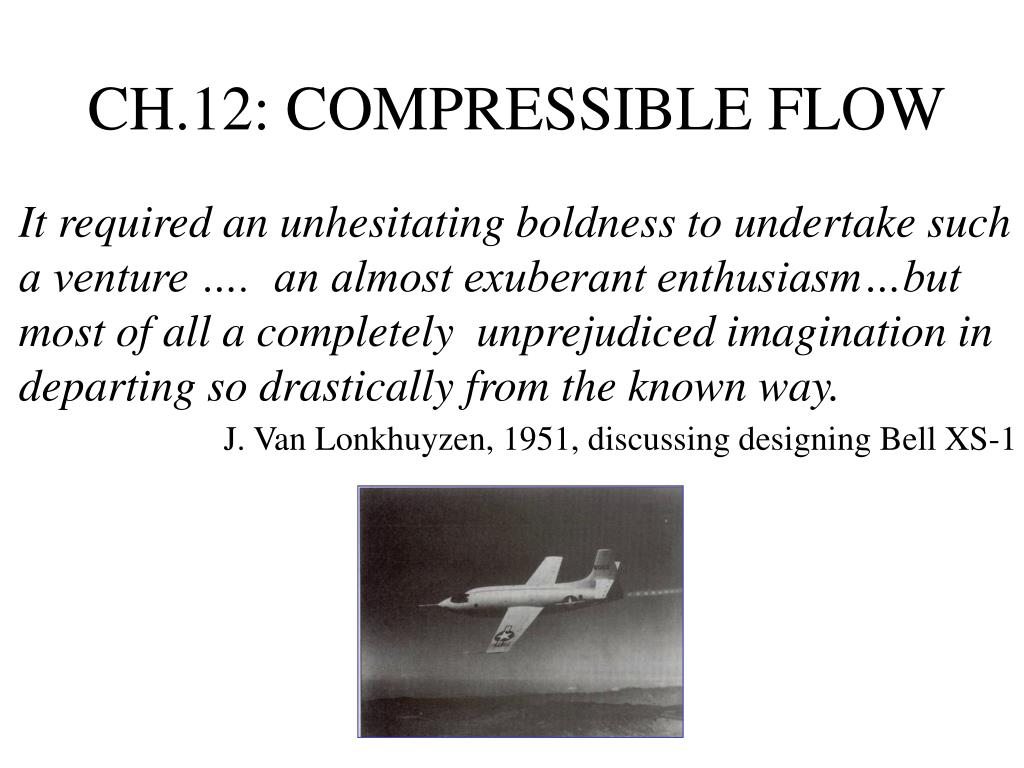
CH.12: COMPRESSIBLE FLOW. It required an unhesitating boldness to undertake such a venture …. an almost exuberant enthusiasm…but most of all a completely unprejudiced imagination in departing so drastically from the known way. J. Van Lonkhuyzen, 1951, discussing designing Bell XS-1.
Une image / un lien ci-dessous est fourni (tel quel) pour télécharger la présentation
Politique de téléchargement : le contenu du site vous est fourni TEL QUEL pour votre information et votre usage personnel ; il ne peut être vendu, concédé sous licence ni partagé sur d’autres sites sans l’accord de son auteur.Le contenu vous est fourni TEL QUEL, pour votre information et votre usage personnel uniquement.Téléchargez la présentation en cliquant sur ce lien.Lors du téléchargement, si vous ne parvenez pas à télécharger une présentation, l’éditeur a peut-être supprimé le fichier de son serveur.Pendant le téléchargement, si vous ne parvenez pas à obtenir une présentation, le fichier a peut-être été supprimé par l’éditeur.
F I N
Plus de contenu associé
Transcription de la présentation
CH.12: COMPRESSIBLE FLOW It required an unhesitating boldness to undertake such a venture …. an almost exuberant enthusiasm…but most of all a completely unprejudiced imagination in departing so drastically from the known way. J. Van Lonkhuyzen, 1951, discussing designing Bell XS-1
ASSUMPTIONS • ALWAYS ~ • Steady Flow • Ideal Gas • Ignore Body Forces • only pressure work • (no shaft, shear or other work) • Constant specific heats • “One – Dimensional” • MOSTLY ~ • ISENTROPIC
“quasi-one-dimensional” Flow properties are uniform across any given cross section of area A(x), and that they represent values that are some kind of mean of the actual flow properties distributed over the cross section. NOTE – equations that we start with are exact representation of conservation laws that are applied to an approximate physical model
One-Dimensional Compressible Flow f(x1) f(x2) + s1, h1 +s, h2 7 Variables = T(x), p(x), (x), A(x), v(x), s(x), h(x) 7 Equations = mass, x-momentum, 1st and 2nd Laws of Thermodynamics, Equations of State (3 relationships)
One-Dimensional Compressible Flow Variables = T(x), p(x), (x), A(x), v(x), s(x), h(x) Equations = mass, momentum, 1st and 2nd Laws of Thermodynamics, Equation of State (3 relationships) Cons. of mass (steady / 1-D) Cons. of momentum (& no FB) Cons. of energy (& only pressure work) 2nd Law of Thermodynamics . Ideal gas Ideal gas & constant cv, cp Ideal gas & constant cv, cp (steady) Eqs. of State
Affect of Change in Velocity on Temperature Velocity Increases, then Temperature Decreases Velocity Decreases, then Temperature Increases NOT DEPENDENT ON MACH NUMBER Isentropic, steady, cp&cv constant, no body forces, quasi-one-dimensional, ideal gas, only pressure work
Affect of Change in Velocity on Pressure dp/+d{Vx2/2}=0 Velocity Increases, then Pressure Decreases Velocity Decreases, then Pressure Increases NOT DEPENDENT ON MACH NUMBER Isentropic, steady, no body forces, quasi-one-dimensional
Affect of Change in Area on Velocity dV/V = - (dA/A)/[1-M2] M <1 Velocity and Area change oppositely M > 1 Velocity and Area change the same Isentropic, steady, no body forces, quasi-one-dimensional
Affect of Change in Area on Pressure dp/(V2) = (dA/A)/[1-M2] M <1 Pressure and Area change the same M > 1 Pressure and Area change oppositely Isentropic, steady, no body forces, quasi-one-dimensional
isentropic, steady, ~1-D Subsonic Nozzle Subsonic Diffuser (dp and dV are opposite sign) M<1 If M < 1 then [ 1 – M2] is +, then dA and dP are same sign; and dA and dV are opposite sign qualitatively like incompressible flow
isentropic, steady, ~1-D Supersonic Nozzle Supersonic Diffuser (dp and dV are opposite sign) M>1 If M > 1 then [ 1 – M2] is -, then dA and dP are opposite sign; and dA and dV are the same sign qualitatively not like incompressible flow
And this is the reason!!!!!!! If is constant then dA and dV must be opposite signs, but for compressible flows all bets are off, e.g. for M>1 both dV and dA can have the same sign
WHAT HAPPENS AT M = 1 ? ? dp/(V2) = (dA/A)/(1-M2); dV/V = -(dA/A)/(1-M2); d/ = (dA/A)[M2/(1-M2)]
If M = 1 have a problem, Eqs. blow up! Only if dA 0 as M 1 can avoid singularity. Hence for isentropic flows sonic conditions can only occur where the area is constant. dp/(V2) = (dA/A)/(1-M2); dV/V = -(dA/A)/(1-M2); d/ = (dA/A)[M2/(1-M2)]
What happens to dp and d across the throat in a supersonic nozzle with steady, isentropic flow? dp/ = - d{Vx2/2} Vx continues to increase so p continues to decrease d/ = (dA/A)[M2/(1-M2)] (dA/A)[M2/(1-M2)] is always negative so continues to decrease
What happens to dp and d across the throat in a supersonic diffuser with steady, isentropic flow? dp/ = - d{Vx2/2} Vx continues to decrease so p continues to increase d/ = (dA/A)[M2/(1-M2)] (dA/A)[M2/(1-M2)] is always positive so continues to increase
Connexion au compte
Connectez-vous pour publier votre contenu sur SlideServe.