Download
1 / 2
20 likes | 143 Vues
This study explores how the existence of hierarchical subcultures influences financial performance. By comparing manager and non-manager perceptions of organizational culture, we find that financial performance improves when these perceptions are aligned. The indicators used to assess financial performance include sales growth, market-to-book ratio, return on assets (ROA), and return on investment (ROI). The Denison Organizational Culture Survey was utilized to measure cultural perceptions, revealing that misalignment, particularly in involvement, negatively impacts financial metrics such as ROI and ROA.

E N D
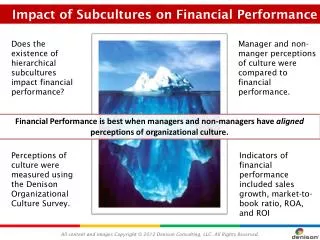
Impact of Subcultures on Financial Performance Does the existence of hierarchical subcultures impact financial performance? Manager and non-manger perceptions of culture were compared to financial performance. Financial Performance is best when managers and non-managers have aligned perceptions of organizational culture. Indicators of financial performance included sales growth, market-to-book ratio, ROA, and ROI Perceptions of culture were measured using the Denison Organizational Culture Survey.
Aligned Involvement & Financial Performance Market-to-book ratio will decrease as managers and non-managers diverge on opinions of involvement Manager and non-manager divergence is predictive of less return on assets (ROA) Financial performance most impacted by (mis)alignment of Involvement between managers and non-managers Misalignment of involvement perceptions coincides with negative impacts on return on investment (ROI)