Download
1 / 17
170 likes | 281 Vues
This resource explores the properties of parallelograms, focusing on finding side lengths, angle measures, and segment lengths. A parallelogram is defined as a quadrilateral with both pairs of opposite sides parallel and congruent. Through a series of examples and practice problems, it illustrates how to determine the lengths of the sides using the congruence of opposite sides, as well as how to find missing angle measures using properties of opposite and consecutive angles. Ideal for students learning geometry concepts related to polygons.

E N D
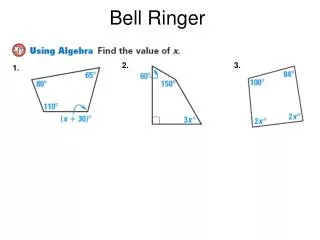
2. 3. 1. Bell Ringer
Parallelogram • Parallelogram – is a quadrilateral with both pairs of opposite sides parallel.
Example 1 Find Side Lengths of Parallelograms FGHJ is a parallelogram. Find JH and FJ. SOLUTION JH=FG Opposite sides of a are congruent. Opposite sides of a are congruent. =5 Substitute 5 for FG. FJ=GH =3 Substitute 3 for GH. ANSWER In FGHJ, JH =5 and FJ = 3.
Now You Try Find Side Lengths of Parallelograms 1. ABCD is a parallelogram. Find AB and AD. AB = 9; AD = 8 ANSWER
Example 2 Find Angle Measures of Parallelograms PQRS is a parallelogram. Find the missing angle measures. SOLUTION By Theorem 6.3, the opposite angles of a parallelogram are congruent, so mR = mP =70°. 1. 2. By Theorem 6.4, the consecutive angles of a parallelogram are supplementary. mQ + mP =180° mQ + 70°=180° Substitute 70° for mP. Consecutive angles of a are supplementary. mQ=110° Subtract 70° from each side.
Example 2 Find Angle Measures of Parallelograms The measure of R is70°, the measure ofQ is110°, and the measure of S is110°. ANSWER By Theorem 6.3, the opposite angles of a parallelogram are congruent, so mS = mQ =110°. 3.
Find Angle Measures of Parallelograms Now You Try ABCD is a parallelogram. Find the missing angle measures. 2. ANSWER mB=120° mC=60° mD =120° 3. ANSWER mA=75° mB=105° mC =75°
Example 3 Find Segment Lengths TUVW is a parallelogram. Find TX. SOLUTION TX= XV Diagonals of a bisect each other. =3 Substitute 3 for XV.