Understanding Topographic Maps: Uses and Contour Guidelines
This chapter explores the various uses of topographic maps, including determining land relief, hydrologic features, and cultural landmarks like highways and buildings. Engineers and architects rely on these maps for planning and design, while contractors utilize topographic data for earthwork without overlooking important contour rules that describe elevation changes. Key methods of collecting topographic information—such as satellite imagery, aerial photography, and GPS—are discussed, alongside essential principles for interpreting contours, including slope indicators and the significance of contour intervals.

Understanding Topographic Maps: Uses and Contour Guidelines
E N D
Presentation Transcript
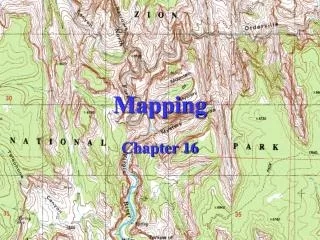
Mapping Chapter 16
Uses of Topographic Maps To determine the topography or relief of a tract of land. To determine hydrologic features such as drainage basins, streams, rivers and bodies of water. To determine the cultural features or man-made features such as highways, railroads, dams and buildings. Topographic maps are used by engineers and architects to determine building layouts, utility connections and drainage requirements. Contractors use topographic information to determine earthwork requirements.
Methods of Collecting Topographic Data Satellite Imagery Aerial Photography Existing Topographic Maps Field Work Total Station GPS
Control for Topographic Surveys Horizontal Control: Establish Traverse. Vertical Control: Establish Elevations from Benchmark.
Contours Used to Determine Topography
Contours Contour lines are lines of equal elevation. The contour interval is defined as the difference in elevation between contours.
Rules for Drawing Contours Contour lines must close upon themselves. They cannot simply dead-end. Contours are perpendicular to the direction of slope. The slope between contour lines is assumed to be uniform. In other words, contour lines are assumed to be man-made. The distance between contours indicates the steepness of the slope. Concentric closed contours represent hills or depressions.