Download
1 / 9
90 likes | 203 Vues
This overview highlights the key domestic policies of Presidents John F. Kennedy and Lyndon B. Johnson, emphasizing the "New Frontier" initiatives aimed at addressing poverty, civil rights, and economic growth. Kennedy’s focus on minimum wage increases, social security extensions, and boosting the economy through tax incentives and military spending laid the groundwork for Johnson’s Great Society, which sought comprehensive civil rights reforms, healthcare expansions, and educational opportunities. The impact of these policies reshaped American society during the 1960s.

E N D
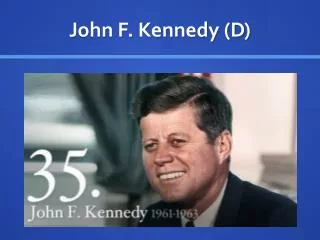
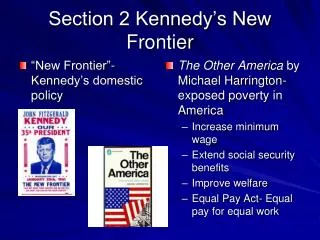
Section 2 Kennedy’s New Frontier • “New Frontier”- Kennedy’s domestic policy • The Other America by Michael Harrington- exposed poverty in America • Increase minimum wage • Extend social security benefits • Improve welfare • Equal Pay Act- Equal pay for equal work
Stimulate the Economy • Tax credits to encourage business investments in new factory equipment • Increase military spending to create new jobs and boost economy • Deficit spending- borrow money in order to spend more money • Tax cuts for the middle class • Heavier taxes for the wealthy
Civil Rights • Mostly stayed passive about civil rights in the beginning of his term • Civil Rights Act of 1963 • “Space Race” • Soviet Union launched satellite Sputnik 1 in 1957 • 1958 Congress created NASA • 1961 Soviet Yuri Gagarin became first human to orbit the earth • U.S. committed to landing a man on the moon by 1970 • John Glen became first American to orbit the Earth in 1962 • Neil Armstrong was the first man to walk on the moon in 1969
Kennedy’s assassination • November 1963 he went to Texas to campaign for his 1964 re-election • Lee Harvey Oswald sat in the window of the Texas School Book Depository • Vice President Lyndon B. Johnson was sworn into office • Millions of people watched Kennedy’s funeral on TV
Section 3 Johnson’s Great Society • Johnson’s background • Grew up in Texas • Texas State College • Taught at a school for Mexican Americans • Johnson enters politics • Secretary for a Texas Congressman • Head of the National Youth Administration • 1937 he was elected to the House of Representatives • 1948 he was elected to the Senate • Rose to Senate Majority leader • 1960 JFK picks him as VP
Civil Rights Act of 1964 • Outlawed discrimination in voting, education, and public accommodations • Created Equal Opportunity Commission • War on Poverty • Train the jobless, educate the uneducated, and provide healthcare • Economic Opportunity Act • Created the Job Crops • Established Vista
1964 Presidential Election Republican Democrat Lyndon B. Johnson Federal government could best regulate the economy and promote social justice Won 60% of the popular vote • Barry Goldwater • Federal government was the problem in social and economic issues
The Great Society • Healthcare • Medicare • Medicaid • Education • Funds to aid schools in poorer communities • Protect the Environment and the Consumer • Rachel Carson’s Silent Spring • Ralph Nader’s Unsafe at Any Speed • New Immigration Policies • Immigration and Nationality Act of 1965
Supreme Court Reform • Warren Court • Chief Justice Ear Warren • Congressional Districts • Baker v. Carr (1962) • Reynolds v. Sims (1964) • Rights of the Accused • Mapp v. Ohio (1961) • Gideon v. Wainwright (1963) • Escbedo v. IL (1964) • Miranda v. AZ (1966) • Separation of Church and State • Engel v. Vitale (1962) • Abington v. Schempp (1963)